
The Ultimate Question 2.0: NPS Book Review

Fred Reichheld published The Ultimate Question in 2006, at a time when thought-leaders started investigating the impact of customer service on a company’s success and profitability. Telephone complaints lines and long-form surveys had been the customer feedback solution of choice for an eternity, but it was becoming clear that these weren’t enough to truly measure customer satisfaction.
Churn, customer retention, and customer loyalty are key metrics of success and profit, but the means to measure customer satisfaction – i.e., the reason for retention or churn – were not plentiful. Because of this, it didn’t take long for companies globally to adopt Reichheld’s idea of the Net Promoter Score, that offered a simple and effective way to measure customer loyalty.
The first edition of the book defined detractors, promoters and passives as three categories of customers, identified by their response to a question of loyalty; “would you recommend us to a friend?” The resulting Net Promoter Score, scaled from 0-10, kept results simple and easily identifiable for companies to analyze.
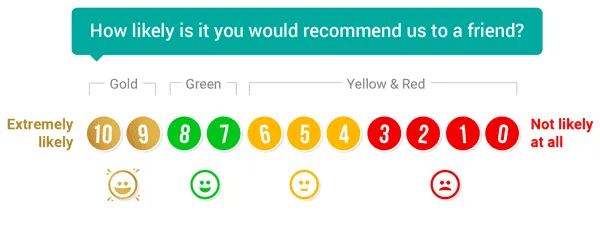
The updated, 2.0 edition of The Ultimate Question, released in 2011, offers an update on how NPS users in those few years had turned it from a Score to a System, fundamentally altering the outlook for customer service and the ethos it had grown amongst their employees.
What was once a subject-broaching instructional book has become a portfolio of customer success stories and lessons learned, with some big-name companies sharing the effect Net Promoter Scores/Systems have had on their business, both internally and financially. Whatever your preferred CSAT solution, The Ultimate Question 2.0 offers an evaluative view of the customer satisfaction industry thus far that’s timelessly helpful in its self-reflection. Grab a coffee and read on for our highlights…
- Read more about NPS in our Ultimate guide to Net Promoter Score (NPS)
The Ultimate Question 2.0 review: Top 5 takeaways
- Detractors are costly. It’s simple but worth emphasizing – not only will they leave negative reviews and bad-mouth the business to friends and colleagues, but for those with long-term contracts or limited by market offerings, detractors often become a nuisance, complaining, taking up time and causing unnecessary costs. Because of this, it’s important to identify and face detractors sooner than later – resolve issues where possible and try and avoid acquiring similar customers in future.
- Customer surveys have transformed from a score to a management system with three central components. One, the categorization of customers into promoters, passives, and detractors; two, the measurement of this by a simple metric/score; and three, learning to frame success using this metric, and driving motivation to improve based on increasing promoters and decreasing detractors. This turns NPS from a score to a system, enabling businesses to drive better results and strive towards greatness.
- There remains a disconnect between our accounting systems and our want for loyal customers. We know that loyal customers come back more, purchase additional products, refer friends, leave great and useful feedback, and – most of all – cost less. Yet what is still tracked each and every day is often purely financial indicators. Ignoring feelings of loyalty, enthusiasm, recurring purchases, etc., makes it harder to determine the economics of existing revenue. This is because customer loyalty is a far softer and less tangible measurement; despite our best efforts, there’s still room for improvement.
- There is such a thing as ‘good’ and ‘bad’ profit. In the short term, bad profits are easily acquired through unfocused advertising, unrealistic deals, poorly managed customer expectations, and so on. What makes it ‘bad’ is that this profit is made at the expense of customers, and customer loyalty will eventually be lost. Good profit is based on a truly engaged and loyal customer, one who is so delighted by service that they are keen to return and to recommend your business. In terms of NPS, these are your promoters, and their good profit is likely to last.
- **True customer loyalty isn’t purely based on value.**Sure, the price, quality and ease of use of your product/service is essential, but there’s more to it than that. Reichheld argues that the customer must “feel good” about their relationship with the brand – that the company understands and values them and that they share similar principles. Another way to view this is that the company engages both the customer’s head and their heart. The ultimate question, ‘would you recommend us to a friend?’, relies on the customer viewing the company highly enough to take care of a friend as well as themselves – emphasis on not only the rational but the emotional too.
The Ultimate Question 2.0 review: Top 5 quotes
“Only by systematically measuring its effect on people and their relationships can an organization gauge whether it is really achieving its mission and enriching lives. That’s NPS’ reason for being. It provides a practical measurement process that can accurately assess a company’s progress. It provides a management system that can help a company capture the spirit and drive toward greatness.”
“NPS ultimately is a business philosophy, a system of operational practices, and a leadership commitment, not just another way to measure customer satisfaction.”
“The ‘how likely’ question is merely a practical shorthand for the question of whether you are treating others the way you would want to be treated. It brings the whole thing back to earth, and to business. The purpose of a survey, after all, is not to begin a philosophical discussion or to launch a lifelong relationship. It is to create workable categories and a score that can facilitate action. It is a way of making business relationships better.”
“Loyalty, after all, is a strong and value-laden concept, usually applied to family, friends, and country. People may be loyal to a company that they buy from, but they may not describe what they feel in those terms. If they really love doing business with a particular provider of goods or services, however, what’s the most natural thing for them to do? Of course: recommend that company to someone they care about.”
“A high NPS in and of itself is not the real objective, because a high NPS by itself does not guarantee success. NPS merely measures the quality of a company’s relationship with its current customers, and high-quality relationships are a necessary but not a sufficient condition for profitable growth… a company must build an army of promoters, but it will squander the potential they create if it can’t then make effective decisions about risk, pricing, innovation, cost management, and everything else necessary for sustainable, profitable growth.”
The updated version of the Ultimate Question offers an insightful look back on the beginning stages of modern day customer satisfaction metrics – both how NPS developed as a system and also how the conversation transformed to recognize the relationship between customer and company. Whatever your preferred CSAT metric, the book is worth reading for its evaluative nature as we head into 2020’s, where CX is more important than ever.
Want another book review to peruse?
If you liked this one, we’ve got plenty others…
- Blue Ocean Shift is highly recommended, it’s practical, insightful and really worth reading for anyone in the CX space.
- Our top 5 takeaways and quotes from “Quirkology” Richard Wiseman’s book on the science of every day behavior.
- “Rebel Ideas” by Matthew Syed is one of our reads of the year! We really loved this one and quite a bit of it chimes with Blue Ocean Shift too.