
How to create and use Customer Journey Maps to better map your customer experiences
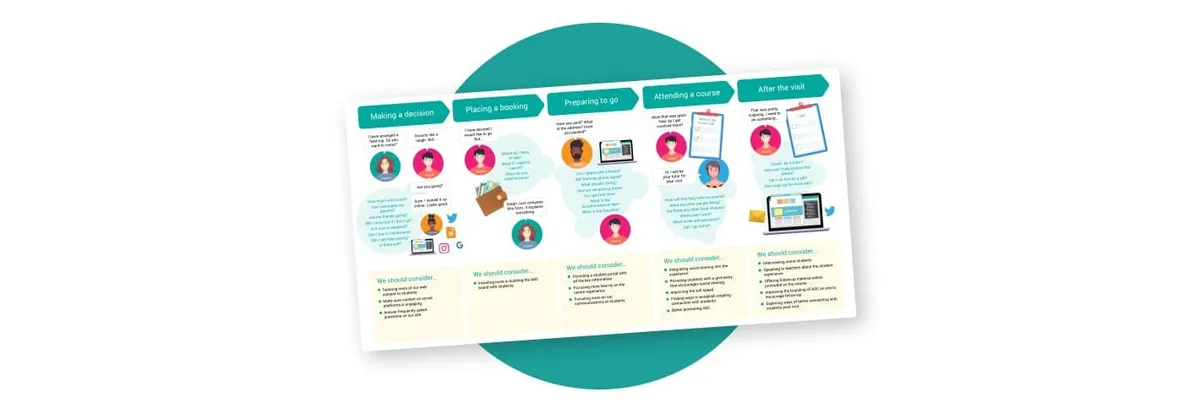
A customer’s experience is based on far more than a transaction. It’s a ‘customer journey’ with various milestones, interactions and events along the way. This guide explores the concept of the customer journey map, and how organizations can create and apply them to optimize the customer experience.
What is a customer journey map?
A customer journey map is a representative map of the customer journey. It is a visual representation of a typical customer’s journey with you. It is commonly used as a management tool for planning and process optimization. In other words, laying out the stages that customers go through so that these can be improved and refined by the organization – resulting in better business outcomes.
What is generally included in a customer journey map?
The customer journey map is intended to show how a customer interacts with the organization during its ‘lifecycle’. The map is typically framed as a series of sequential stages, each of which is completed by the customer before proceeding to the next. Therefore, a simple customer journey map will include:
- Details about the typical customer persona/s, such as expectations, goals, demographics, etc. Also how they are emotionally responding to aspects of the customer experience during their journey. For example, in terms of satisfaction, anticipation, fatigue, etc. This data can be collected via customer feedback.
- Each of the core stages of the customer lifecycle (this could be expressed, for example, as ‘Awareness, Evaluation, Purchase, Installation, Use, Renewal’)
- Each of the specific customer touchpoints where the customer comes into contact with the organization or its communications, in relation to each lifecycle stage.
- Each of the processes and actions that the customer must perform during each stage (e.g. watch an ad, complete an order form, book onboarding session, contact support, etc.)
- Each of the communications channels used in the touchpoint interactions
Types of customer journey maps
There are different types of customer journey maps you can use, depending on what you’re trying to achieve.
The future state customer journey map
This kind of customer journey map shows an ideal scenario for how customers can experience the product/service/organization throughout their lifecycle. It is not the product of research into the current customer journey, but rather an aspirational vision of what might be possible.
The current state customer journey map
This type of customer journey map is designed to overview the current state of the customer journey. This gives a simple customer perspective on how the organization currently works to serve customers. It is a useful strategic foundation for identifying and diagnosing areas that may warrant change. It can be used to compare against a future state customer journey map to show differences and a prioritized work plan for change.
Simplified journey map overview
Some customer journeys can be very long and complex. This can make customer journey maps unwieldy to interpret and present. A simplified view strips out much of the detail so that only the key strategic aspects are brought into focus. This type of customer journey map comes in handy when used to gain support from senior decision makers.
Granular, single stage/process/action journey map
At the opposite end from a simplified journey map is a deeply granular journey map. These typically focus on a single stage of the customer journey, or even a single action. For example, how customers can return a product. The granular focus is warranted because it enables teams to break processes down into their constituent parts and gain a full appreciation of what customers go through.
Persona-led journey map
All customer journey maps envisage the journey through the eyes of a customer. Persona-led journey maps are incredibly specific about an individual persona, or even a real customer example. These contain rich detail about the customer’s emotional responses to each interaction. It can be extremely valuable to map out how different personas respond to the same customer journey, or how the same consistent persona responds to differently design customer journey stages.
For further reading, check out these 7 great books on customer journey mapping.
Why do you need to use a customer journey map?
Why should you map customer journeys? Principally because it allows organizations to see everything from the customer’s perspective. This is central to shaping a customer experience that engenders customer loyalty, satisfaction and referrals, which in turn improves staff morale and retention. Here’s a comprehensive list of reasons why customer journey mapping is a good idea.
- It’s good for business. According to McKinsey, using customer journey maps the right way has the potential to increase customer satisfaction by 20%, lift revenue by 15% and reduce the cost of serving customers by up to 20%.
- It gets the whole business onto the same page. Customer journey maps are objective and evidence based. They are rooted in the reality of process and interaction. Plus they’re also easy to understand. A great way to promote a shared understanding across an entire organization about the customer experience.
- It presents insights you didn’t already know. The process of creating customer journey maps is revealing – a real voyage of discovery. These insights are extremely valuable for future decision making.
- It’s a roadmap for improvement. Customer journey maps point out opportunities to improve the customer experience and better utilize optimal resources. This can be at the strategic level (e.g. making the whole journey faster and more streamlined) or on a more granular footing (e.g. optimizing a communications channel to reduce the friction in a customer-related process).
- It inspires further customer-centricity, feedback and dialogue. A customer journey map is a collection of sequenced touchpoints, each of which is a chance to learn more about customers, ask questions and respond accordingly. Customer voice and customer feedback programs benefit enormously from the panorama provided by customer journey maps.
Why it’s so important?
Organizations find it difficult to carry the customer perspective through into their planning and operational activities. They want to be customer focused, and typically understand that this is important. However, businesses are working flat-out to follow their own goals, and so are employees. Being oriented around what the customer wants to achieve, and shaping products and services and a way of interacting with customers to satisfy that, is actually very hard. This is especially true of large organizations.
Customer journey mapping is an essential activity when attempting to understand customers from the outset, and to ensure this understanding is kept front and center as it evolves. Companies that don’t map the customer journey have an underdeveloped appreciation of what customers go through when dealing with them. They literally miss out on important details; insights that come from diligently executing a customer journey mapping process. This puts them at a competitive disadvantage, makes them less responsive to customer needs and can accelerate the rate of customer churn.
How to create a customer journey map
You’re going to need the right skills and resources in place to create a customer journey map. It all revolves around understanding the customer and how they interact with your organization as they journey through their lifecycle.
STEP 1: Get a team together that covers every aspect of your business
Bringing the right team together is a critical first step. These will need to be people who engage with customers from lots of different angles. For example, not just ‘customer-facing staff’ but people who deal with billing interactions, product development and service delivery too. This will bring you a variety of perspectives and a rich understanding of every single stage of the customer journey.
STEP 2: Define customer personas
Next is to understand exactly who your customers are. There may be a variety of personas, so concentrate on one to begin with. A persona is an invented character based on an archetypal customer. Make him or her representative of common demographic features like age, educational background and spending power. Enrich the persona with likes and dislikes, as well as expectations and behaviors. Have the team create a ‘profile’ based on past experience with customers. You can test this further by conducting research among your existing customer base.
Include within this a strong understanding of your customer’s goals. What do they want to achieve when going through their customer journey? This is very important in later stages when deciding how certain processes and interactions can be improved. Use analytics data to determine ‘search intent’ on your website. Review past queries submitted by customers at various stages of their journey. And look back at customer support requests to identify recurring issues.
STEP 3: Lay out the main stages of the customer journey
A standard customer journey will have 4 main stages:
- Pre-sales and sales
- Onboarding
- Usage, support and service
- Renewal and growth
You might prefer fewer or more stages to cover the same ground. For example, ‘Awareness, Evaluation, Purchase’. Or, as expressed earlier in the guide, ‘Awareness, Evaluation, Purchase, Installation, Use, Renewal’.
STEP 4: Sequence the many physical and digital touchpoints in the customer journey
Each of the stages you’ve identified will include a variety of customer touchpoints. Touchpoints are the points of interaction that the customer has with your organization and its brand during their journey. These invariably carry some form of communication or exchange of information. Journey mapping consistently throws up many more touchpoints than organizations initially thought to be the case. You may think there are 8–10 touchpoints in your typical customer’s journey, but once broken down and carefully examined it could easily be 30–40.
Just a few examples of customer touchpoints include:
- Paid search ad
- Web page visit
- Social media update
- Social media DM
- Chat session
- Test drive/evaluation
- Support desk enquiry
- Training session
- Meeting confirmation
- Renewal email notification
- Marketing webinar invite
- Pricing quote
- Monthly newsletter
In fact some of these touchpoints are actually composed of several ‘micro-touchpoints’ of their own. For example, the training session might be composed of advertising, invitations, booking processes, confirmations, physical registration, the session itself, post-session coffee/cooldown, thank-you email and follow-ups. Thinking about customer goals is critical to mapping this thoroughly and understanding the customer perspective. On the example of a training session in relation to your product, what is the customer ultimately trying to achieve? What are you doing to facilitate that in a way that meets or exceeds expectations, delivers satisfaction and minimizes friction and effort?
STEP 5: Identify communication channels
There’s a strong element of this in Step 4, but keep in mind that there could be communication channels that you aren’t yet taking full advantage of.
Also, remember that communication is a two-way process. So consider what your customers’ communications preferences are and how consistently you are delivering the same quality of experience across all channels. This again is something you may not already know, so ask customers in order to find out. It will make your customer journey maps more valuable.
STEP 6: Connect systems, processes and resources
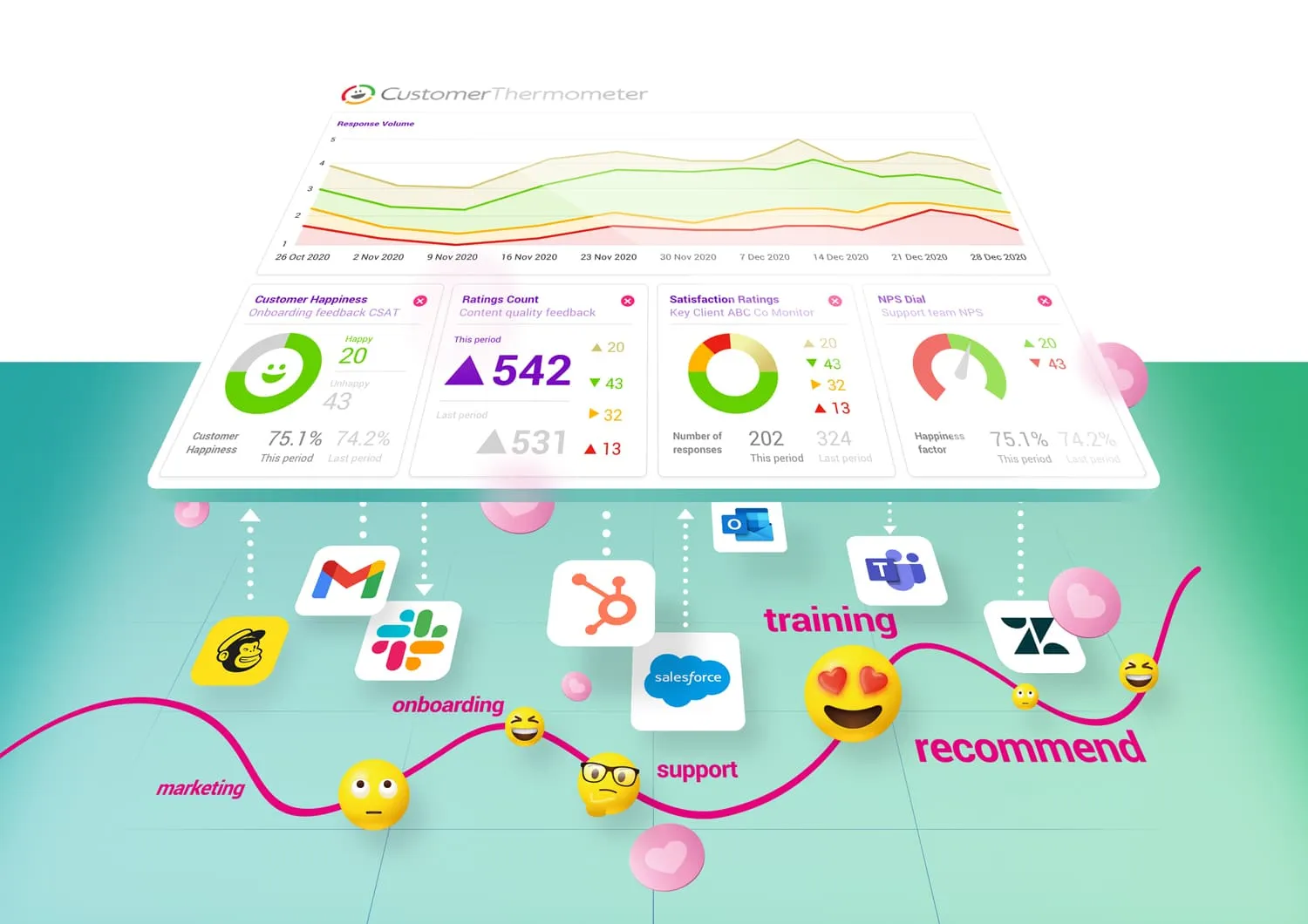
Before actually using the customer journey map, the final stage requires you to attach the systems, processes and resources related to each touchpoint. For example, Salesforce is used as the CRM for outbound marketing email, Zendesk for managing support tickets, etc. This is important because the purpose of the journey map is to identify improvements and make them happen. Connecting systems and processes like this enables you to see what implications there are to planning change.
Customer journey templates
There are many freely available customer journey templates to download, or you could design your own. The best way is to find a basic template that suits your objectives and then refine this to fit your unique requirements.
What all customer journey templates have in common is a landscape page orientation. This supports the linear trajectory of sequential stages, from left to right, as time passes and customers progress through their lifecycle. Even within granular journey maps that look at specific touchpoints and processes, the left-to-right chronology is a consistent feature.
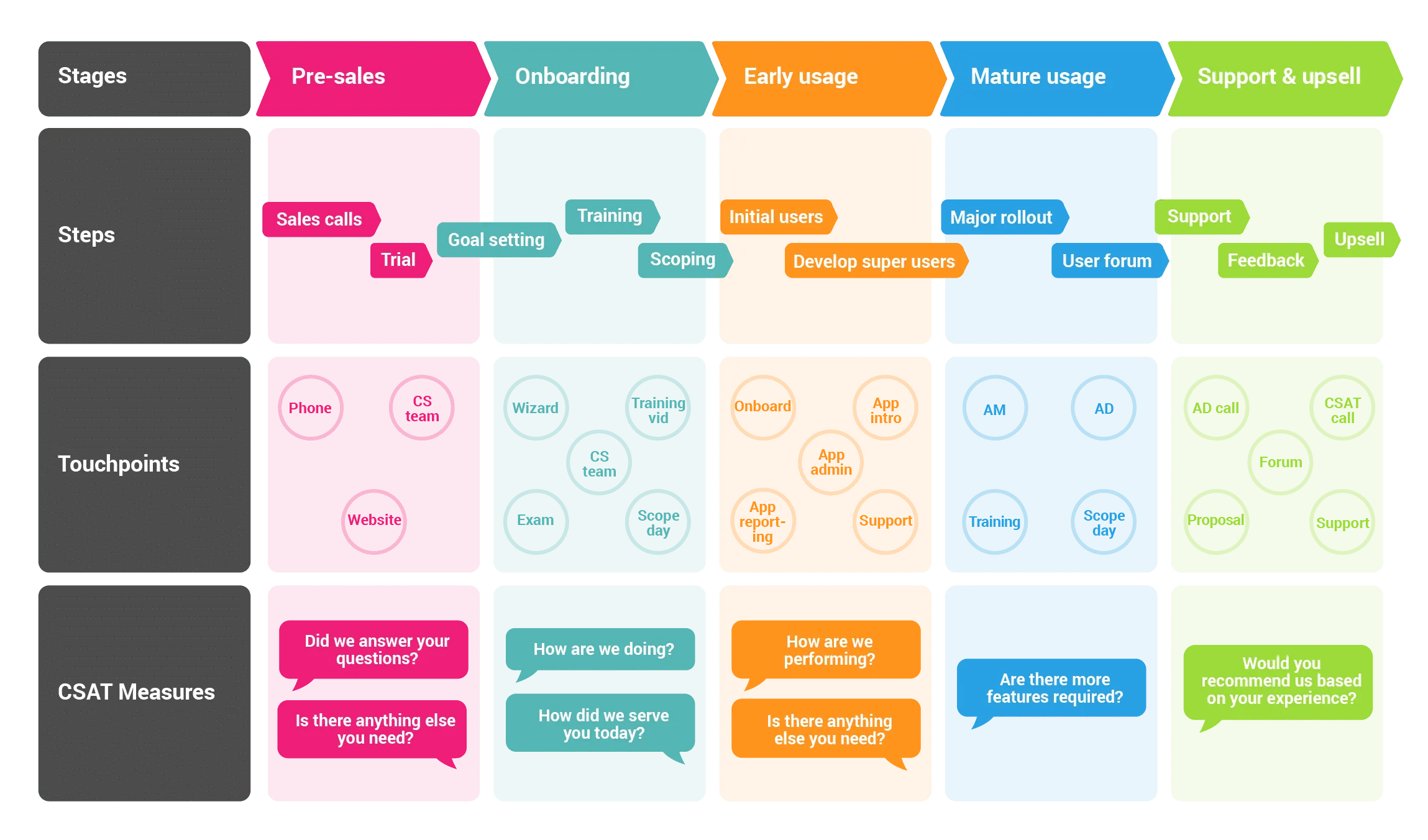
We’ve collected 6 customer journey map template examples in this customer journey map templates. Here’s a condensed summary of what they each entail:
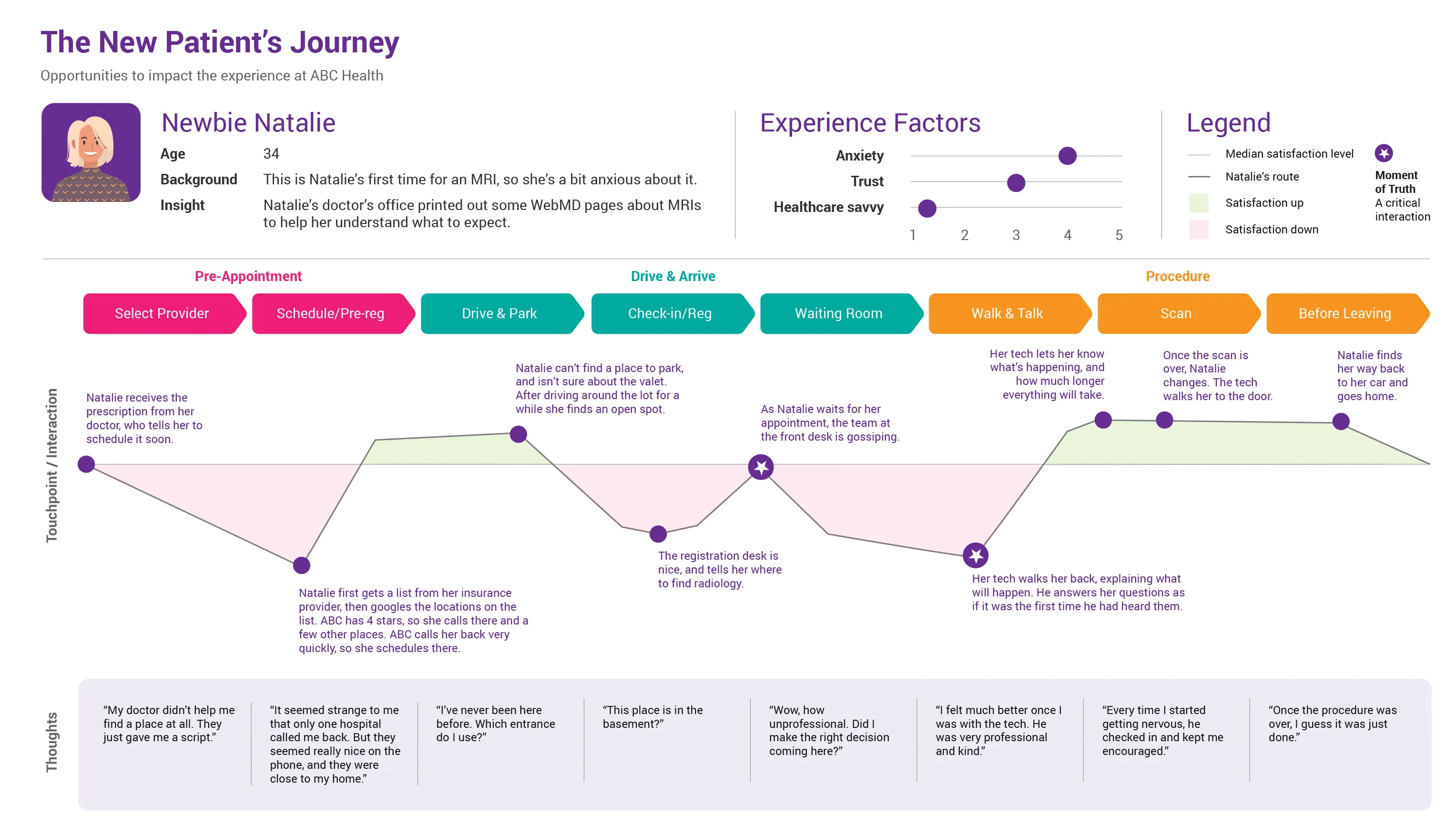
The ‘equilibrium’ template
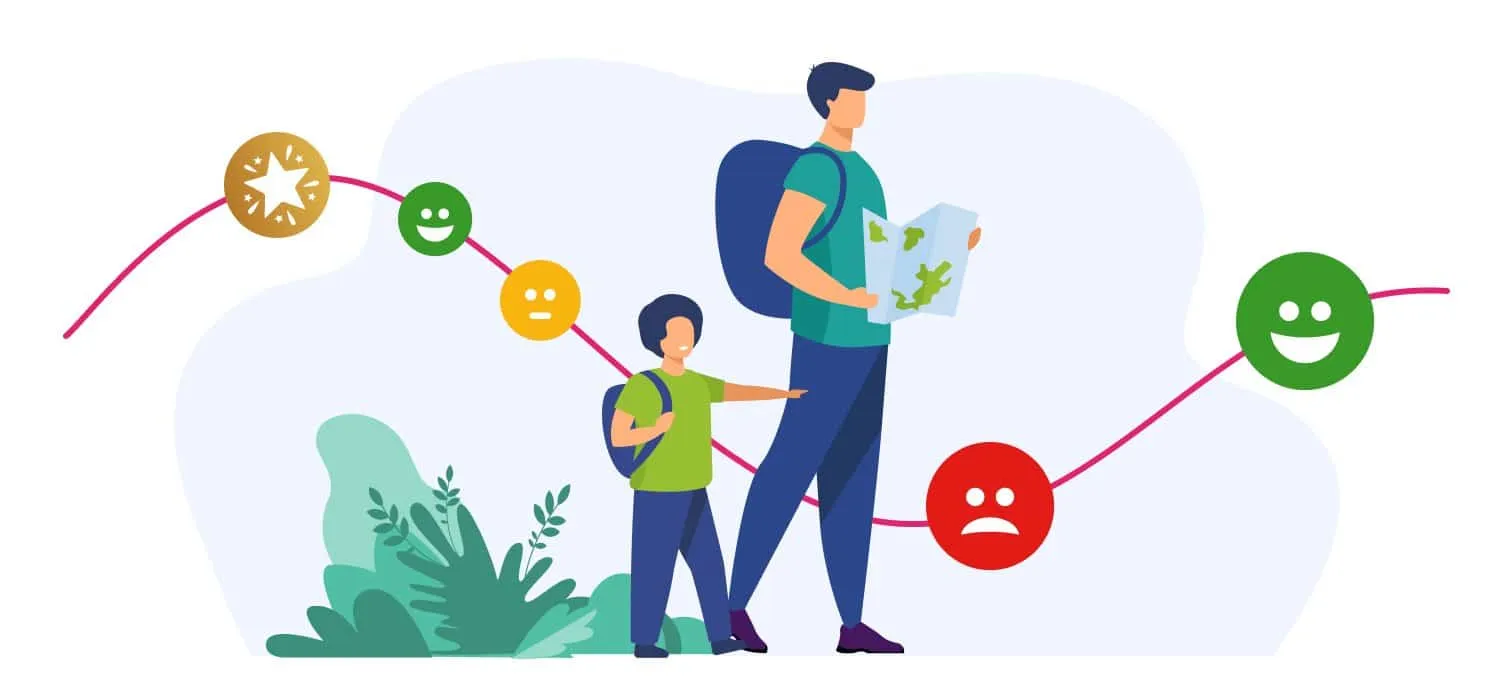
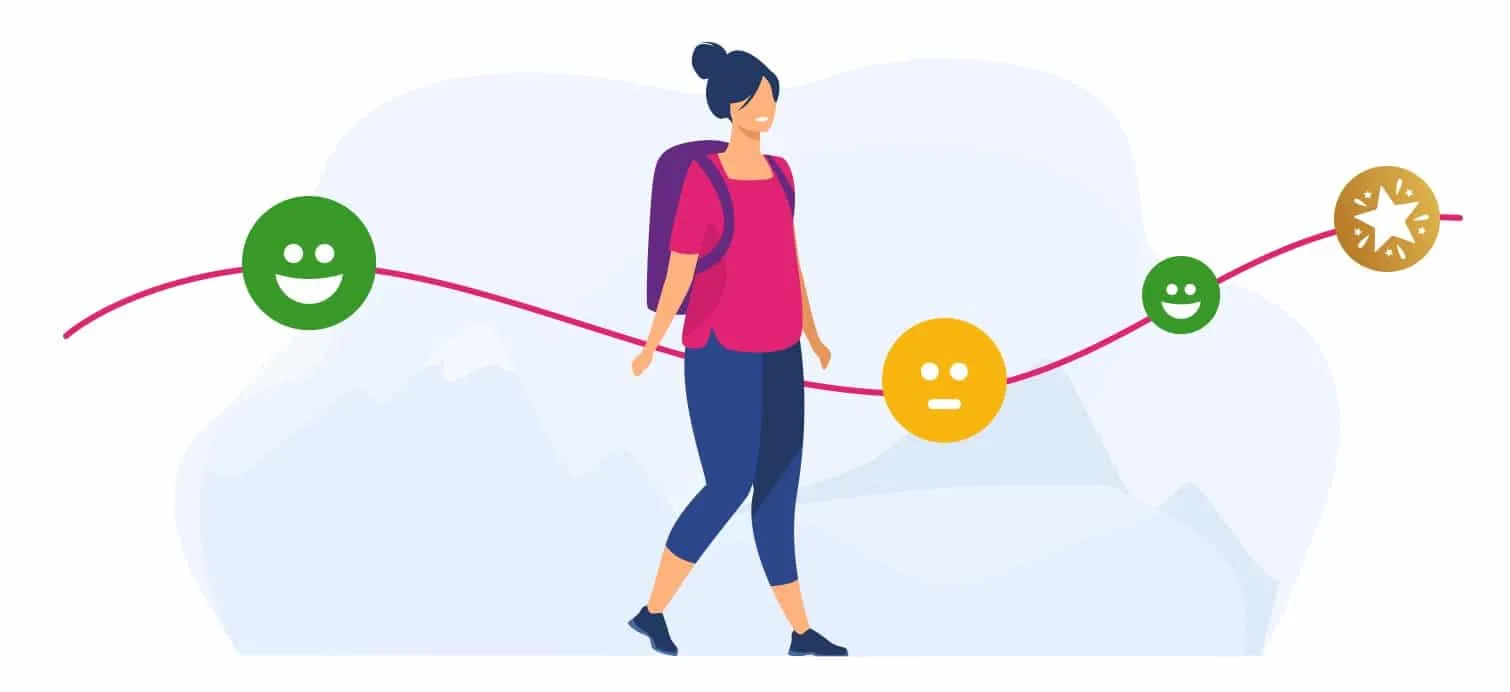
Follows a specific persona through a multi-stage customer journey, showing how customer satisfaction rises and falls following each interaction.
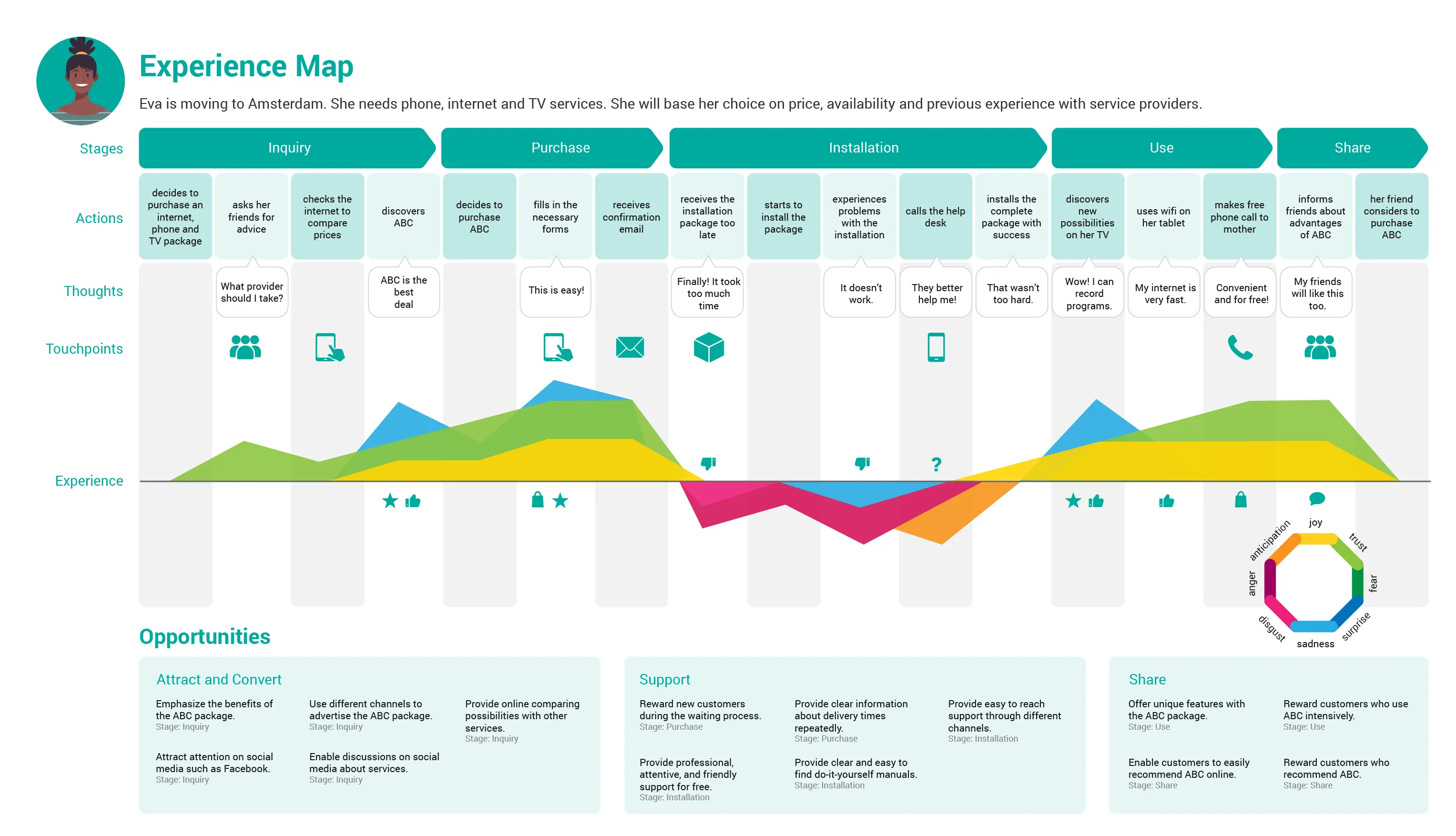
The ‘kaleidoscope’ template
A more structured and multi-layered version of the basic ‘equilibrium’ approach that accommodates more data overall. Includes very rich detail about 8 key emotional responses.
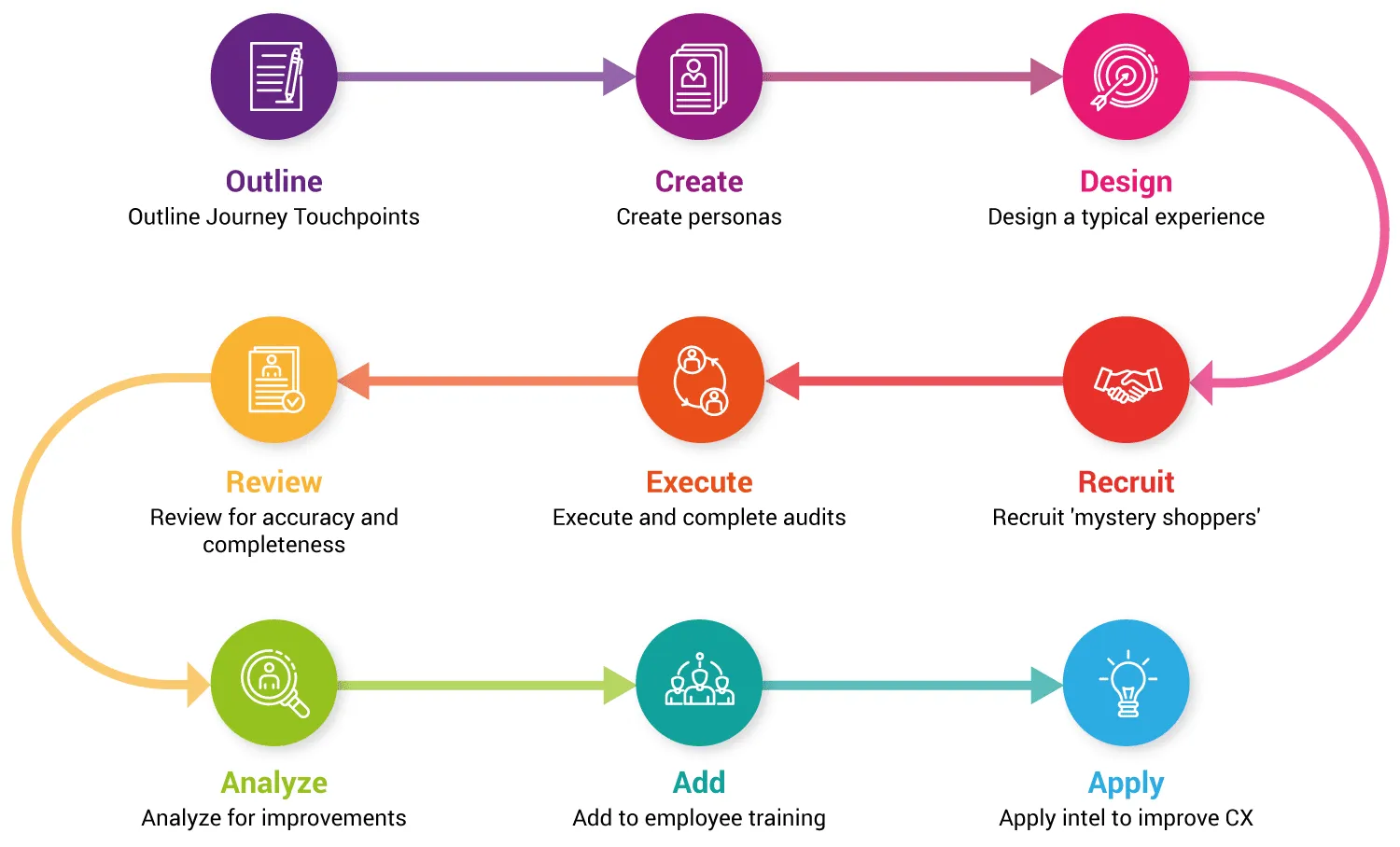
The ‘mystery shopper’ template
A great thinking framework for approaching the journey mapping challenge. It uses mystery shopping as the basis for the customer research you need for making a customer journey map.
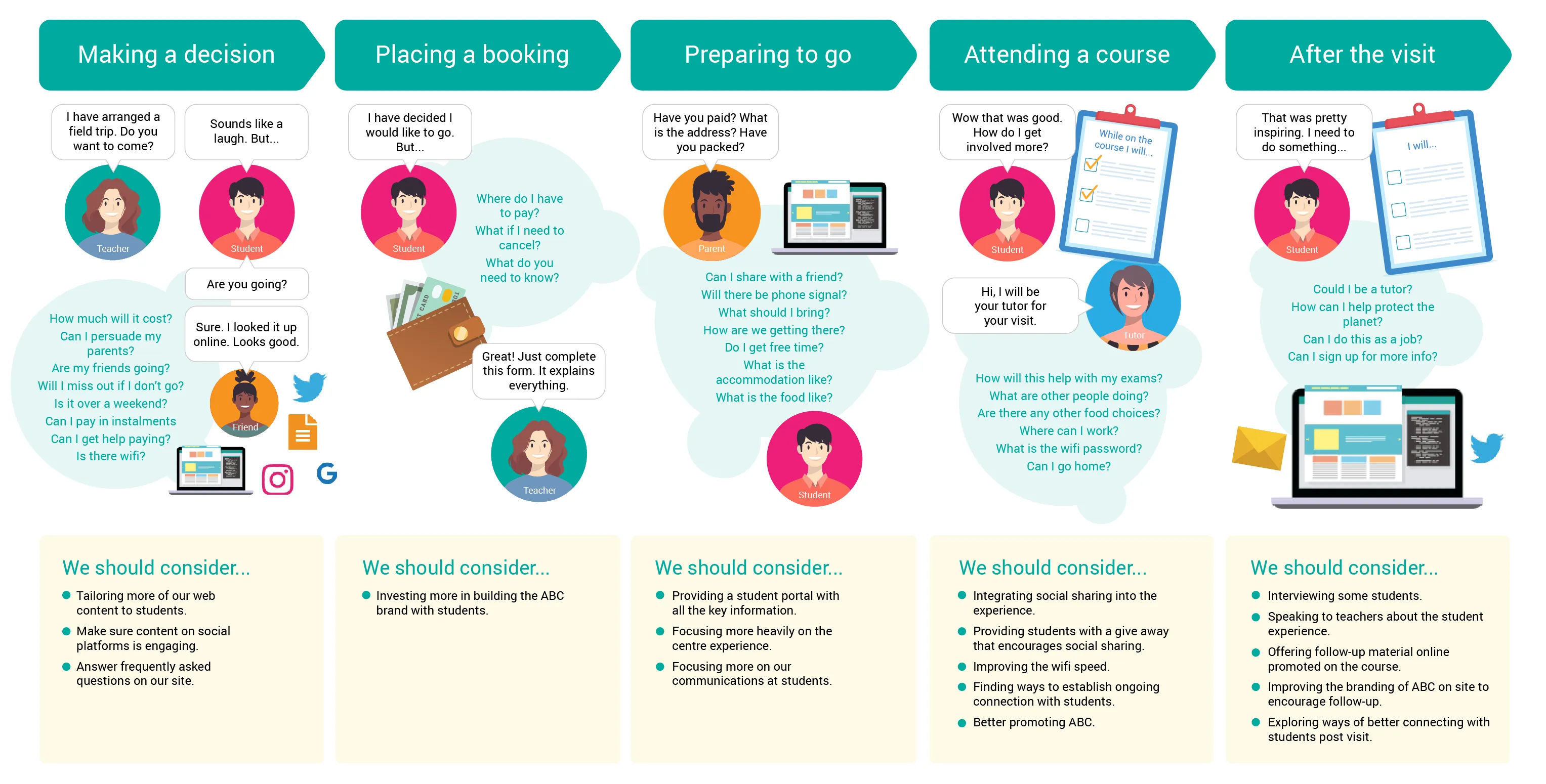
The ‘cartoon strip’ template
A highly visual customer journey map that describes each stage in the customer’s language. Great for helping process-oriented organizations be more human-focused and customer-centric.
The ‘departmental’ template
A stripped-back customer journey map template that focused on the internal process and management implications of customer journey stages and interactions.
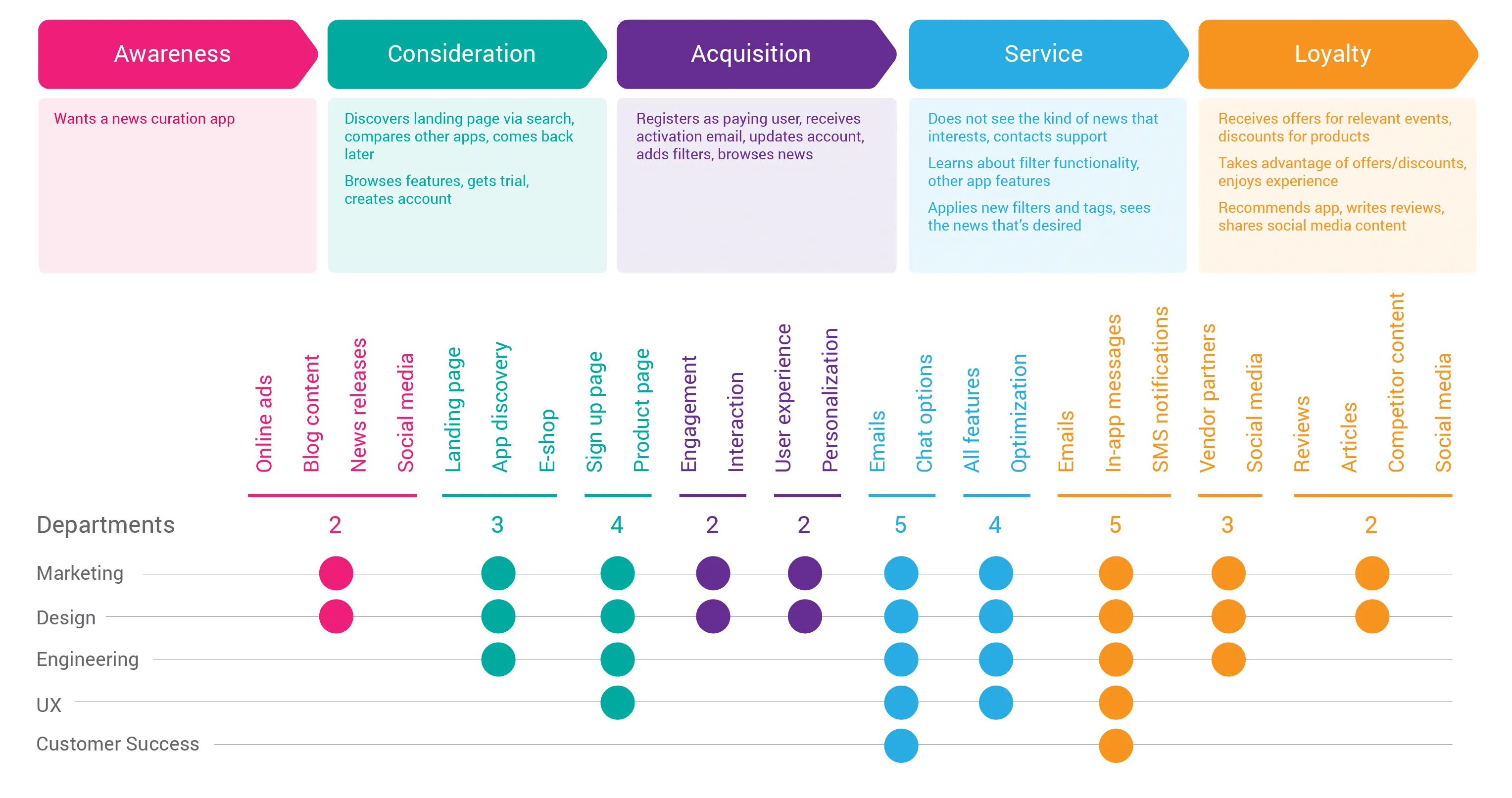
The ‘keep it simple’ template
A high-level blocks and boxes template with all the bases covered. Ideal as a starting point to embellish with extra detail specific to your needs.
Customer journey mapping best practices
How to use a customer journey map to improve customer experience
We find that taking a mystery shopper approach adds huge value to customer journey mapping. Best practice is to use it for both building and interrogating your customer journey map. It puts you into your customer’s shoes and makes you physically encounter every point in the customer’s experience. When doing so, consider the following questions:
- What is the journey like? Is it as you expected? What surprised or disappointed you?
- What might someone search for to find you? Which page on your website will they land on?
- What’s the route for getting in touch? Do some communications channels offer a markedly better or worse experience?
- What happens during key interactions in the sale and usage journey?
- What happens once someone becomes a customer?
This should surface an action list of areas to improve upon, all of which will impact on the overall customer experience.
Author Lou Downe identifies 15 principles of good service design in the best-selling book, Good Services. Each of them majors on the importance of clarity and simplicity. For example (here are 5 of them):
- Be easy to find
- Be consistent throughout
- Require no prior knowledge to use
- Require the minimum possible steps to complete
- Have no dead ends
This thinking should be highly instructive in how you explore and refine customer journeys using the customer journey map as your point of reference.

Identifying and reducing points of friction and improvement opportunities in the customer journey
Now you need to apply this thinking into your customers’ journeys. It’s all about using those physical and virtual customer touchpoints as a starting point from which to delve deeper into the customer experience. What you’re looking for are key events, customer motivations and areas of possible friction difficulty, delay, dissatisfaction and disengagement.
Get all this customer journey mapping detail in front of you and address the following questions:
- What are the main places where customers, and potential customers, are getting stuck?
- Where are customers potentially getting lost or feeling like the process takes too long, is frustrating or requires rework?
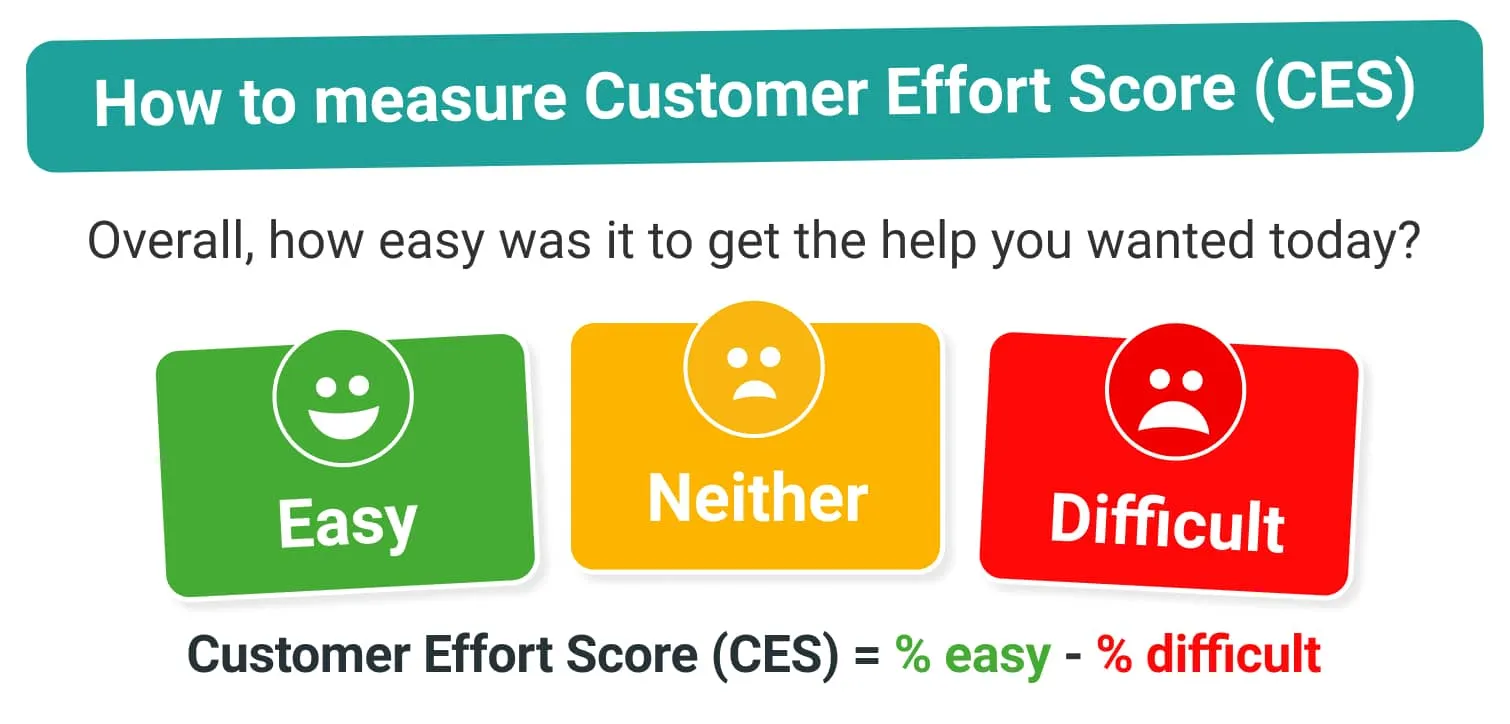
These are opportunities to get your basics right, removing the effort required from customers to perform tasks and achieve their goals. You can even measure the success of these changes by collecting Customer Effort Score feedback data.
You can also take advantage of going beyond ‘brilliant basics’ toward spreading some customer delight and adding ‘magic touches’ by taking a look at 30 brilliant customer service moves. You need to decide where on the customer journey map are the best opportunities to elevate the customer experience to new heights and deliver truly memorable interactions.
How to design an elegant feedback customer journey OR How to use customer feedback to re-map the journey
The customer journey map is also an excellent tool in planning your customer feedback strategy. In fact, customer feedback and customer journey maps complement one another perfectly.
First, let’s remind ourselves of why using customer feedback insights is important to reflecting upon and improving the customer experience:
- Customer feedback helps surface important customer insights at important points during the customer journey. For example, in advance of contract renewals / business reviews.
- Customer feedback can inform how best to address customer requirements with appropriately constructed propositions.
- Customer feedback enables you to optimize processes and even design new services based on what customers like and ask for.
- Customer feedback can be externalized to showcase benefits through real case examples.
- Customer feedback can trigger rapid response to new technical requirements and business challenges – both on an individual basis and across a customer cohort.
- Customer feedback promotes a greater understanding of customers, which in turn better enables greater cross-selling and upselling success.
- Customer feedback is essential to building a customer-centric culture and reputation, which in turn aids customer retention as well as attracting new customers.
It all begins with mapping all the touchpoints within the customer journey. Then you can identify where it makes greatest sense to gather feedback (i.e. in terms of where it is most logical and most technically feasible). This customer feedback could take many forms, from simple metrics such as CSAT and NPS, through to more qualitative feedback.
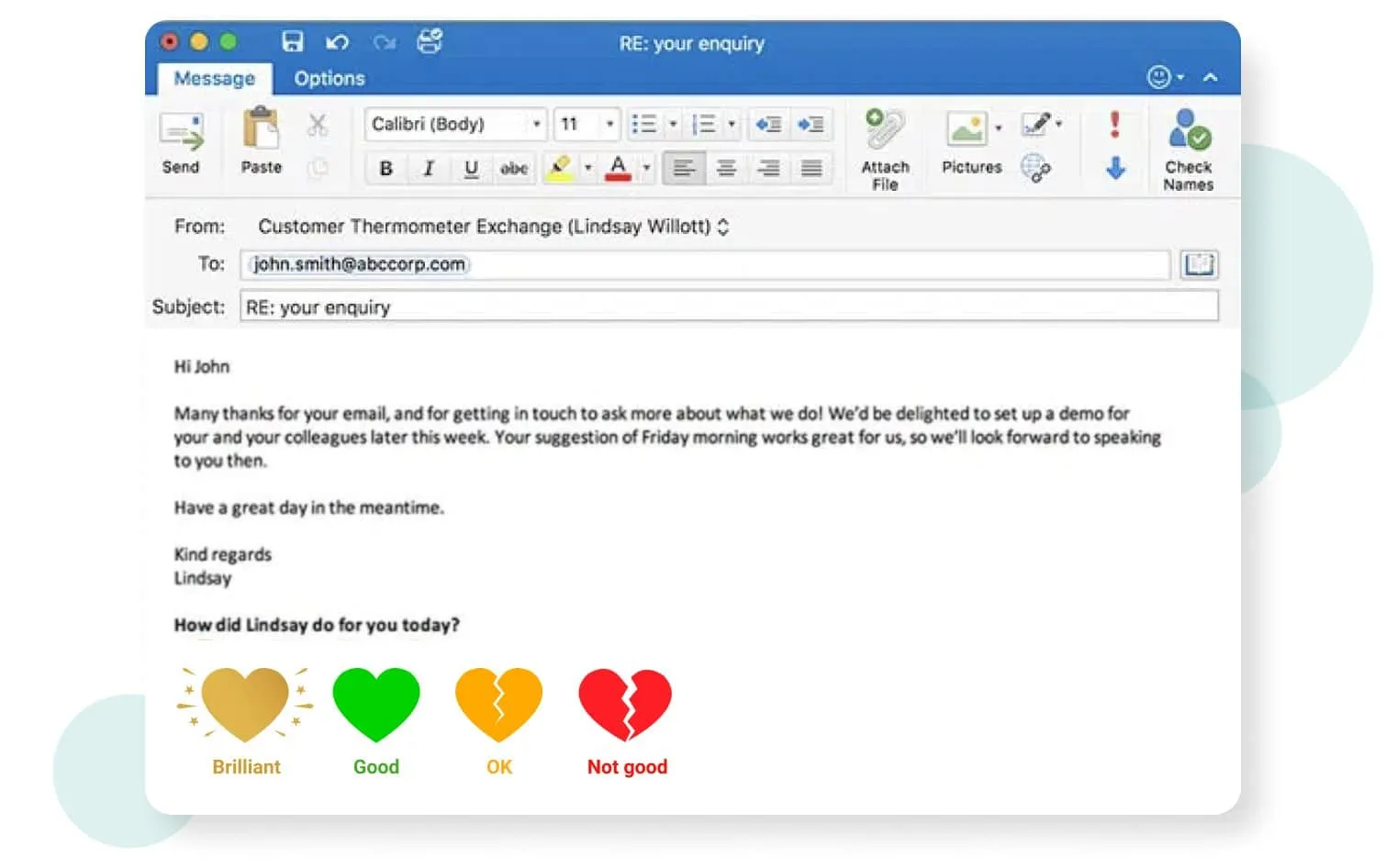
Remember that these customer feedback opportunities are appropriate to their context. For example, asking how satisfied a customer is directly after they’ve completed an interaction will be contextually relevant to that interaction. Naturally, you might want to design the customer feedback question to make that explicit.
Use a lightweight customer feedback mechanism
Clearly this requires a customer feedback process that is very lightweight and flexible. And also engaging enough to be reliably counted upon to elicit a high response rate.
‘Asking for feedback’…
- Can hitch a ride on one of your many existing customer touchpoints. Map the customer journey to uncover them all
- Is like asking a favour, so make it a small one (one question at a time)
- Shouldn’t fatigue your customers, so make it quick and easy to do
- Shows you’re listening, so ensure a rapid response
- Must be driven by questions that are appropriate to the context of the touchpoint being used
We recommend simple one-click customer feedback surveys that can be embedded into existing email communications. It’s what Customer Thermometer is famous for!
How to apply customer feedback to touchpoints in the pre-sales and sales stages of the customer journey map
The pre-sales and sales stage of the customer journey is all about attracting customers. This is partly inbound and outbound marketing, and partly sales process.
- For outbound marketing, touchpoints include sales emails, marketing promotions and newsletters. Each represents an opportunity to garner feedback, and fine-tune marketing tactics based on the insights found. Do more of what’s working and less of what isn’t!
- Inbound elements include customer references that you publish, or are published on third-party reviews sites. Use every opportunity here to demonstrate that you encourage and listen to all kinds of feedback from customers about their experience/s.
- In terms of your sales engine, there are various ways of using customer feedback to optimize it. For example, you could get feedback on your proposals and how individual sales reps operate out in the field. Apply feedback where relevant to show you where it’s possible to shorten sales cycles and close deals more successfully.
How to apply customer feedback to touchpoints in the onboarding stage of the customer journey map
Onboarding is a crucial part of the customer journey (particularly in B2B). It’s where customers use the product or service for the first time. Getting this right at the first opportunity is crucial to retaining customers for the long term.
- Touchpoints might include discovery audits, setup elements of the billing process, activities in relation to the start/switchover day, and any training events.
- Customer feedback is very important here for determining the satisfaction of customers and how reality is stacking up against their expectations.
- Are they getting what they expected?
- Are they getting what they need to achieve their goals?
- What else can be done to make them happy?
- Onboarding processes are typically multi-stage with a series of sequential steps and variables. Aim for a process of continual improvement; always looking for innovations that reduce friction and effort, and make customers more satisfied. Use customer feedback to test how well received your tweaks are.
Applying feedback opportunities across the business
How to apply customer feedback to touchpoints in the usage, support and service stages of the customer journey map?
Customer service teams and expert support centres are generally well-versed at applying feedback mechanisms at the close of each interaction. These provide valuable snapshots,
but not the whole picture. Let’s look at where customer feedback fits in, through the prisms of customer success and customer support.
- Customer success programs are designed to attune to what customers are trying to achieve through their purchase, and give this to them. There are numerous touchpoint opportunities to sense for this, so that customer requirements can be met.
- Ask simple, non-disruptive questions
- Make customers feel valued for the feedback they give
- Ensure close technical integrations between feedback tools and other systems (e.g. CRMs, service desk platforms, dashboards, etc.)
- Get senior leadership buy-in on the strategic value of customer feedback
- Reward and incentivize staff who are implicated in customer feedback
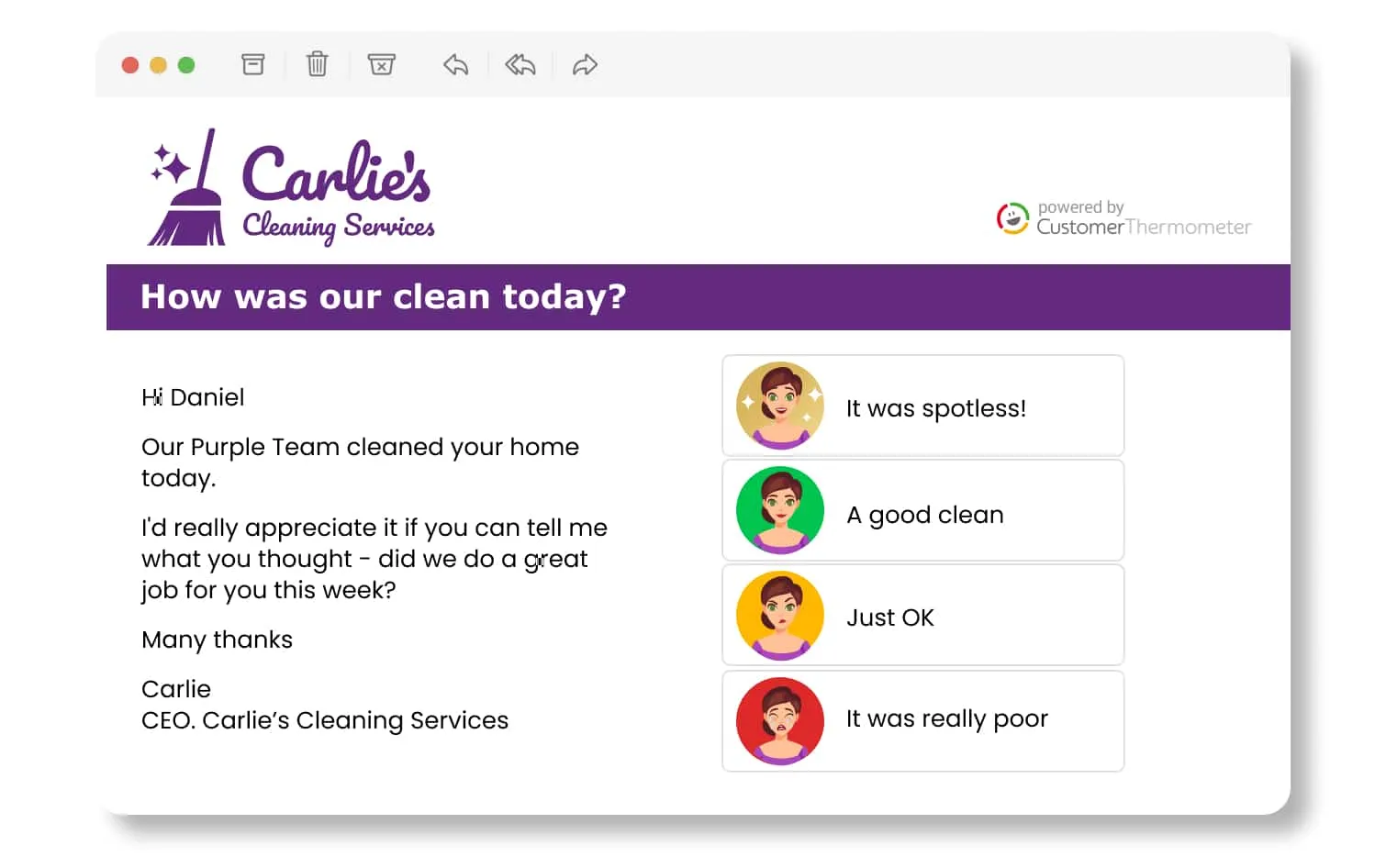
- Touchpoints for customer support and service typically revolve around the reactive enquiry and ticketing closure process. You may be supplementing this with regular customer check-ins (e.g. NPS/CSAT metrics) too.
- Plan ahead with a feedback response framework that accelerates how you deal with positive and negative feedback
- Route positive feedback to ‘thank you’ and ‘how could we improve further’. Try to encourage positive customers to share comments on social and/or post reviews.
- Route negative feedback to apology, factfind and remedy.
- Put applicable escalation paths in place to notify and involve senior colleagues where appropriate
- Commit to a culture of continual learning to improve performance of people and processes.
- Be wary of “OK” customers (the ones who tend to be neither positive or negative in their feedback). Don’t be complacent and allow them to drift in this state without intervening. Otherwise they will churn.
- Plan ahead with a feedback response framework that accelerates how you deal with positive and negative feedback
Get Customer Feedback Along The Customer Journey
Give Customer Thermometer a try and start sending Customer Feedback Surveys in minutes. Our free trial should give you plenty of opportunities to experiment with fast, effective feedback surveys. We integrate with practically every platform and generate some of the best response rates in the business. Simply fill out the form below and fire up your customer feedback program.
Your name *
Your company *
Your email address *
Your password *
Comments