
5 Reasons You Should Encourage Customer Complaints

Customers Complaints Will Force You To Improve Your Product/Business
Criticism can be tough to take. It’s hard to know which feels more sickening – customer complaints that feel unfair or surprising, or those where you know you messed up.
It’s never a good idea to hide from any customer complaints, no matter what. In fact, you should be going out of your way to encourage customers to complain. Why? Because inviting customer complaints is one of the very best ways to improve customer retention.
1. Without customer complaints, you aren’t getting the whole story
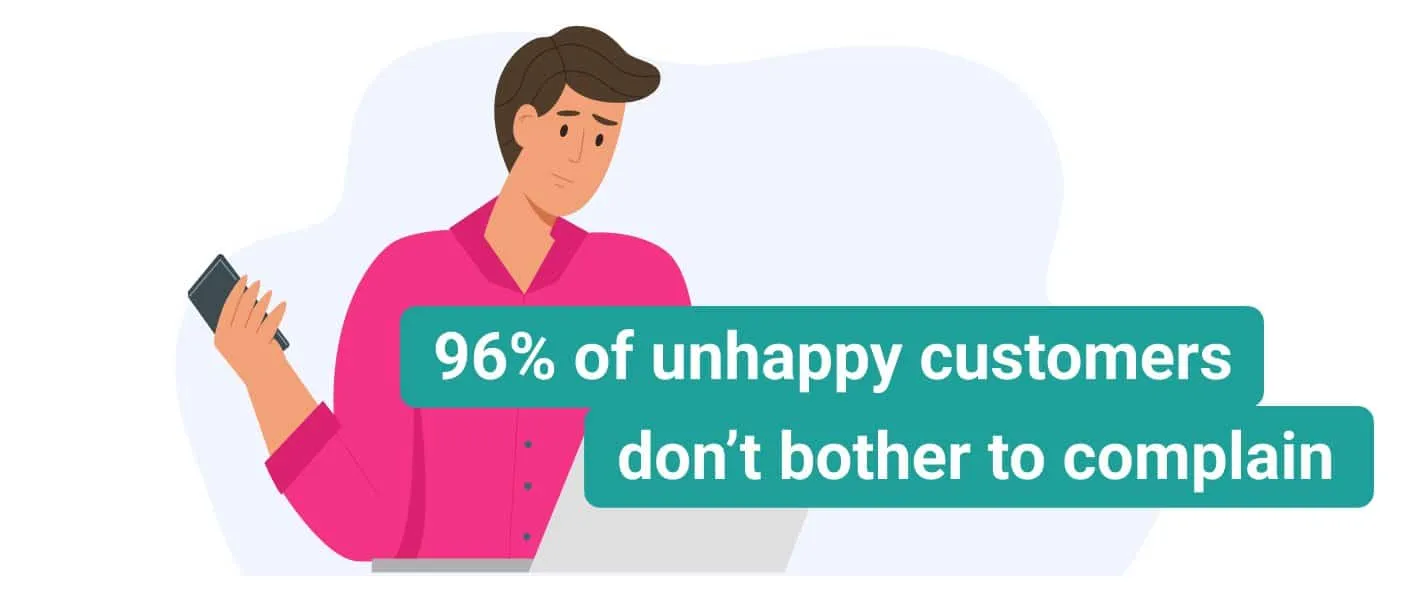
The vast majority of unhappy customers (research shows around 96%) don’t bother to complain, they simply walk away. So you’re only hearing from 4% of your unhappy customers. That means you’re missing out on two opportunities. The first is the opportunity to prevent those customers from leaving by making things right. You can only achieve this if you ask customers for feedback regularly enough. The second is the opportunity to learn from them in order to change things so you can stop other customers leaving.
Imagine what golden insights the 96% or so of ‘non-complaining customers’ could give you. Think about what that 96% are saying to their peers about your company. Imagine what you could start, stop or keep doing as a result of learning from their feedback and taking appropriate action. Imagine what this could do for your company’s customer retention levels.
Customer complaints are extremely illuminating. It’s also free market research. You should be paying for insights this valuable. But you don’t have to when customers volunteer their views and experiences, or respond to your feedback request.
2. Routing customer complaints to your door stops bad news spreading
Negative word-of-mouth (WOM) has a higher impact and spreads faster than positive WOM. A study by the University of Nottingham has shown that
“80% will vent their anger to at least ten people
and 20% sound off to at least 20 others ! Happy customers, by contrast, will only bother to tell 3 people.”
Social media and third-party review sites have made this phenomenon even more dangerous. Often, brands will only know they have an angry customer in their midsts when they pick up on published feedback. In other words, feedback that wasn’t fed back to them.
In this context, it should make perfect sense to any organization that it’s really important to capture complaints. Ideally, long before they hit social media. Ask for the problems as soon as you can and fix them quickly.

3. Fixing problems turns angry customers into loyal advocates
Jake Poore, who looked after “service recovery” for Disney, famously said that customers who go home mad tell their story, whereas if you can catch them and make things right, they go home and tell your story.
The point here is that interacting with an unhappy customer not only enables you to shape what happens next. You also get the chance to recast the whole relationship.
Soliciting those mistakes and rectifying them makes that story even better than if there were no mistake at all. This is what’s known as the service recovery paradox.
<
The service recovery paradox is a fantastic opportunity to increase customer loyalty as a direct result of uncovering customer complaints. It shows that the customer’s opinion does not simply return to its pre-problem state after the problem is rectified. It occurs when the act of repairing the problem is sufficiently satisfying and above expectations that overall sentiment returns to a level higher than if the problem never happened.
Think of it this way: the more customer complaints you uncover, the more opportunities you have to fix problems that generate net gains in customer satisfaction and loyalty.
4. Encouraging customer complaints focuses staff on making customers happy
A concerted effort to encourage customer complaints will be visible to internal, customer-facing staff. It should signal to them a cultural shift and a renewed commitment to customer excellence.
The precise form that “encouraging customer complaints” takes is important here. The key elements of this could include:
- Including feedback opportunities as part of regular communications
- Asking customers “how can we improve?”, particular if they have given negative or passive feedback
- Making the complaints process easy to find and follow for customers
- Ensuring that staff are aware of complaints policies and processes, don’t fear customer complaints or “talk customers out of” making them
- Ensuring that staff understand the importance of learning from complaints and other negative feedback i.e. through updated training materials
This approach will make staff acutely aware of how their actions impact customer satisfaction. It becomes part of the fabric of the way you do things as a customer-centric business.
At Zappos for example, all new staff regardless of role, spend time in the customer service department taking customer calls.

5. Soliciting customer complaints and fixing them builds a remarkable business
Many companies struggle to keep the customer at the heart of their business. Over time, processes, new staff and market changes can obscure the original vision and make it difficult to be truly customer-centric. The best customer-serving businesses never lose sight of what their customer really wants.
By constantly and proactively listening, you can introduce little touches that make customers really happy, without breaking the bank. These touches make doing business with you more interesting… making you more talked-about in the process.
Rackspace, for example, is known for its outcomes-oriented services and ‘fanatical support’. This goal keeps them focused.
Ultimately, the more feedback you solicit, the more you can tailor your service to your best customers, fix problems when they arise and keep them for life.
Download our free eBook for more about how and why to start encouraging customers to complain. It promises to do wonders for your customer retention. Let us know how you get on!

Want to get more customer feedback right now?
Want to get more customer feedback right now? Start your Customer Thermometer free trial today!
Your name *
Your company *
Your email address *
Your password *
Comments