
How to make customer feedback an extension of your brand experience

It’s not enough for people to notice your brand, they have to experience it too. This means communicating a brand personality in every customer interaction – one that fits with your values and how you want your business to be perceived.
But what does your customer feedback program say about your brand? For sure, customer feedback will give you insights to help you create and refine the brand experience. The subject of this guide is an exploration into how the ways in which you request, collect, interpret and action feedback can impact the brand experience you provide.
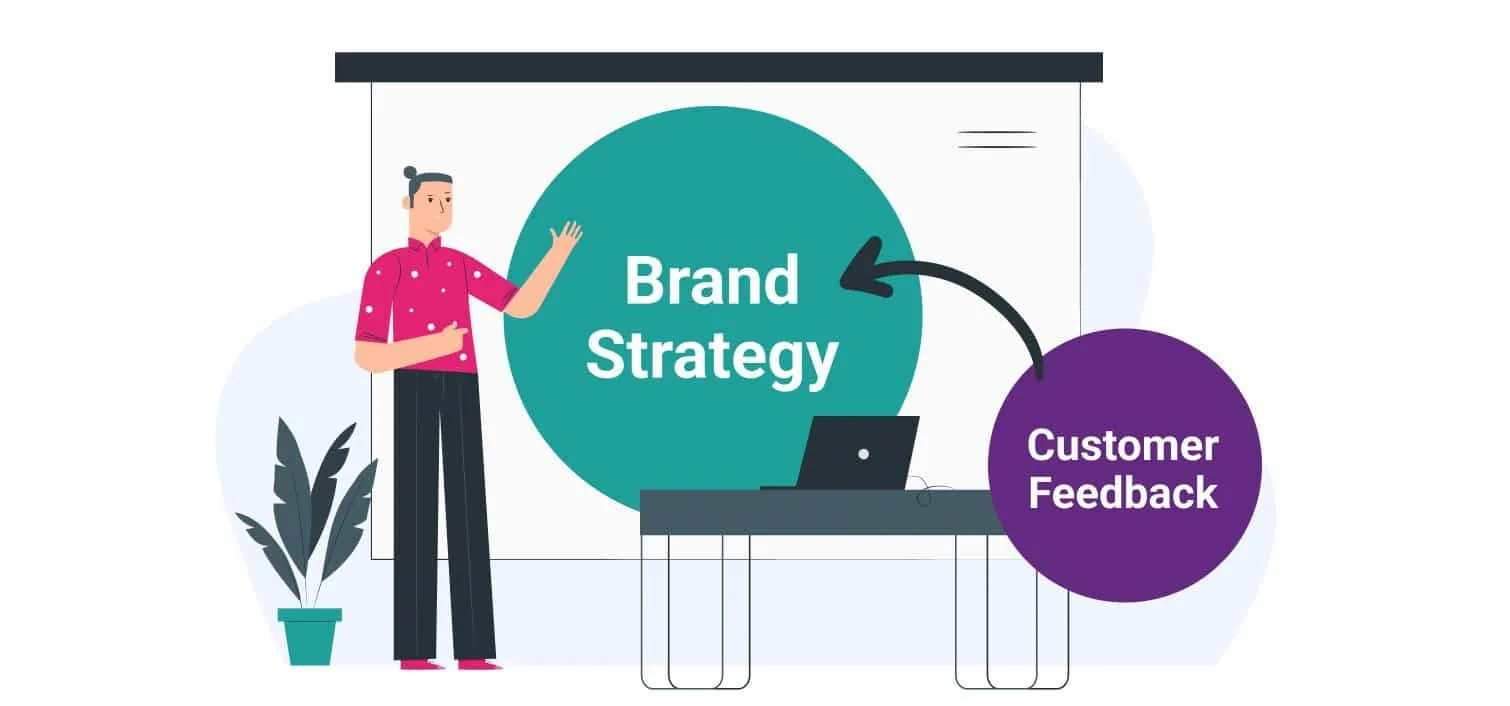
How does customer feedback fit into brand strategy?
Organizations invest a great deal of time and energy in creating brands, ensuring that they resonate with people and stand apart from competitors. Customers get a feel for what’s intrinsically different and valuable about a given brand, to the extent that individuals can relate to them personally. Brand strategy is the science that goes into influencing that to meet corporate objectives.
On the face of it, brand strategy and customer feedback are unrelated other than the helpful input taken from customer perspectives to ensure the brand chimes with its intended audience. At a deeper level it’s clear that every engagement with a customer is an opportunity to perpetuate the brand – every advertisement, every communications exchange, every personal enquiry, every time they use the product or service. Therefore, customer feedback processes naturally get drawn into this orbit.
However, customer feedback isn’t like other communications between brands and customers. In reality, there’s two levels of communication going on. One is seeking to elicit specific insights from the customer about their experience, and relay this to the organization. The other is less explicit; simply the desire to empathize, listen to and understand what the customer feels. Such attentiveness is an appealing quality, giving the impression of a company that cares about its customers and treats their needs with respect.
The other brand-related dimension to customer feedback communications relates to the chosen feedback channel. In email feedback, for example, email surveys are typically designed to align closely with the brand so that the customer’s experience is consistent. This brings customer feedback fully under the purview of brand strategy.
What are the benefits of aligning customer feedback with your brand?
Aligning your customer feedback program with brand strategy has two primary advantages:
- It reinforces your brand identity and builds customer trust and loyalty. All aspects of the customer feedback process – notably those that constitute customer touchpoints or interactions – are opportunities to continue and extend the customer’s brand experience. In other words, customer feedback communications must be branded! By consistently applying how the brand appears and behaves, customers gain greater exposure – building recognition, acceptance, trust, loyalty, understanding and favorability.
- It embodies customer-centricity. The very existence of a visible and energetic customer feedback program is positive proof of a company that puts customers at the heart of its thinking. Whether true or not, the perception is clear. This is good practice for all organizations, but particularly those with a hard-earned reputation for being customer-centric, or that are investing efforts in making this a hallmark of their brand story.

How can your customer feedback approach alter brand perceptions?
Our focus here is on the alignment of customer feedback approaches with brand strategy. That’s important because customer feedback obviously has a wider role in influencing brand perceptions. For example, in how the practice of gathering and responding to customer feedback enables many kinds of improvements to be made, with a consequently positive impact on the brand. By the same token, failing to do so effectively can have a negative effect on the brand.
So, looking specifically at the way in which customer feedback processes are applied in relation to the brand, it’s clear that there are significant upsides (and potential downsides).
- Establish consistency to avoid confusion. If the appearance of the customer feedback engagement is inconsistent with brand expectations then customers may question if something has gone wrong. They may even believe the feedback request to be an email phishing exploit.
- Delight customers by asking for feedback in your brand’s unique voice. The strongest brands are highly trusted. Kevin Roberts’ concept of ‘lovemarks’ explains the emotional bond some customers have with certain brands, the intensity of understanding how they behave and how this helps generate ‘loyalty beyond reason’. All organizations can draw on this by confronting the question, “how would my brand ask for feedback?” Later in this guide we’ll cover some examples of how this can be done, and how powerful it can be when you get it right.
How brand alignment can be applied to each stage of the customer feedback process
Let’s look at some of the key building blocks of the customer feedback process, from a customer’s perspective, and how each can be aligned with the brand to solidify perceptions.
The customer feedback request
Organizations request feedback in many ways, but the most common is email. Email customer feedback surveys are ubiquitous and are triggered at various points during the customer journey. The surveys themselves take many forms, from a long-form questionnaire to a 1-click, single-question survey embedded into the email signature.
Email customer feedback surveys can be engineered in the following ways, from a branding perspective:
- Visual appearance
- Use of brand colors, logos, graphics, statements
- Tone of voice
- Originating sender (name of the person/organization the email is from)
Often customers will be invited to click through to a landing page in order to complete the feedback survey. This should also be branded in a way that’s consistent with both the email and the overall brand experience.
Somewhere should be a statement of thanks with an explanation of what the feedback will be used for (e.g. to improve our service to customers), which also manifestly expresses the values and personality of the brand.
The customer feedback survey questions
The questions asked in the customer feedback survey are also incredibly important to extending the brand experience. Consider the following:
- Are the questions clear and appropriate? Do they reflect customer expectations for what they think the brand is interested in finding out?
- Do the questions sound authentic? Do they feel like ‘the brand’ is asking the question or not? A good example is Virgin. Even people who’ve never flown Virgin may have an impression of what the brand ‘sounds’ like when it talks to you i.e. kind of fun, while also being business-like and straightforward, but in an aspirational and almost luxury way. In that context, asking “please rate the appropriateness of our beverage options from 1 to 5, with 1 representing poor and 5 representing very good” could come across as phony.
Subsequent communications around the feedback
With the customer feedback collection process completed, it’s time to decide what to do next. Best practice is to close the customer feedback loop by contacting the customer and addressing the feedback they’ve raised. This will be particularly necessary if the feedback is negative and the action is to stop the customer churning. Positive feedback is also worth following up to capitalize on goodwill. At the very least, the customer’s effort in providing feedback warrants acknowledgement.
Consider the following:
- Do emails and other official communications use the same consistent visual branding elements?
- Do the communications feel personalized and sincere?
- If a human agent gets involved, do they embody the brand in the same way as the communications leading up to it?
- Is the use of the brand consistent if the customer ‘switches channels’ during the process (i.e. begins on one channel, such as email, but then switches to web chat or phone)?
Results/changes arising from the feedback
The final part of the process, as far as the customer sees, is what happened as a result of their feedback. This is a crucial element as it directly impacts on the customer’s latest, most current and enduring perception of the brand. Brands should imagine this from the customer’s standpoint, and roleplay asking themselves questions like:
- Am I happy that I bothered providing feedback to this brand?
- Did the brand meet the expectations it created in terms of what happens next?
- Did the brand keep all the promises it made to me?
- Did it go better or worse than I expected from this brand?
- Have I felt listened to?
- Did anything change?
- How might I relay my experience of dealing with this brand among my contacts?
- Do I feel motivated to contribute more feedback in future?

Why is it so important to ensure consistent branding through customer feedback channels?
Customer feedback is 24/7 and a constant opportunity for engagement. As we established above, failing to enforce brand consistency is an invitation for creating confusion and failing to meet brand expectations.
Ensuring consistent branding through customer feedback channels is critical to cutting through and becoming recognized, understood and trusted. It fundamentally helps to reinforce brand identity and message to customers. When customers interact with a company through various feedback channels, they expect a consistent experience that aligns with the brand’s values, personality, and appearance. To summarize, consistent branding:
- Creates a sense of familiarity and recognition. Brand recall is higher among customers and they are more likely to remember key benefits and messages.
- Helps establish credibility and trust. Customers conflate consistency with professionalism and a strong sense of reliability and stability.
- Underlines differentiators between a brand and its competitors. A consistent branding approach makes it easier to promote a unique identity that stands out from other brands in the market, making it easier for customers to distinguish and remember.
- Supports brand loyalty. When customers have a positive experience with a brand, they are more likely to remain loyal and recommend the brand to others. Repeated and prolonged brand exposure can also foster stronger emotional connections between brands and customers.
How can you ensure consistent branding through customer feedback channels?
We’ve scoped out the following 5 ways to ensure a consistent brand experience across your customer feedback channels.
Develop and implement brand guidelines universally
Brand guidelines are an invaluable asset in the quest to ensure consistency of your brand everywhere. Brand guidelines define the brand in all its facets and uses, and should be widely distributed and universally adopted by anyone responsible for using the brand externally.
Part of this could include specific guidelines for how the brand should be used in customer feedback processes. At the very least, general guidelines for the appearance, behavior, tone and color palette for the brand should suffice.
Train your team
As with any published guidance, you can ensure its adoption by equipping team members with the requisite training. This process supports objectives for achieving consistency of brand with efficiency and confidence. It also helps raise questions, address concerns and refine guidance so it remains up to date and fit for purpose.

Use consistent brand elements across channels
Perhaps the most obvious step to consistency is applying the same consistent brand elements in various channels and media. This isn’t always straightforward depending on the platforms available. For example, a standard web chat or chatbot service may have limited scope for white-labeling to your brand.
In the realm of customer feedback, the key is to select a feedback survey platform that supports the greatest possible customization for your branding needs (hint: try Customer Thermometer!). This reduces the risk of having to compromise the use of approved brand materials – a definite no-no in any credible brand guidelines.
Add a little extra spice, but ensure it’s true to the brand spirit
Sometimes it’s just not possible to apply a consistent brand element, you have to create something new that aligns with the look, feel and vibe of your brand definition. There’s tremendous scope for creativity and innovation here, but it demands a high level of confidence in really understanding your own brand and how it behaves and is perceived among target audiences.
Customer feedback surveys are a surprisingly rich terrain for elevating the brand experience, by making your customer feedback icons and emojis uniquely on-brand. Read on for some examples of these in action, which we cover in more detail below.
Do not favor one feedback channel over another – treat them all equally
Last but not least, take care to ensure a level playing field for all your feedback channels. Favoring some more than others in terms of your focus upon brand consistency inevitably lessens the overall experience to the lowest quality example. And just because 80% of customer feedback comes through one channel, doesn’t make it OK to neglect the others.
A sensible approach is to treat all feedback as being of equal value, much as it’s wise to treat all customers with an equal amount of respect.

4 great examples of on-brand customer feedback surveys
At Customer Thermometer, we believe the humble customer feedback survey is a rich canvas for expressing your brand. That’s why we allow comprehensive customization of the whole survey experience, incorporating brand elements, colors, images, banners and more.
These examples are from our rich imaginations, showing what’s possible when you submit your brand to the custom icon treatment:
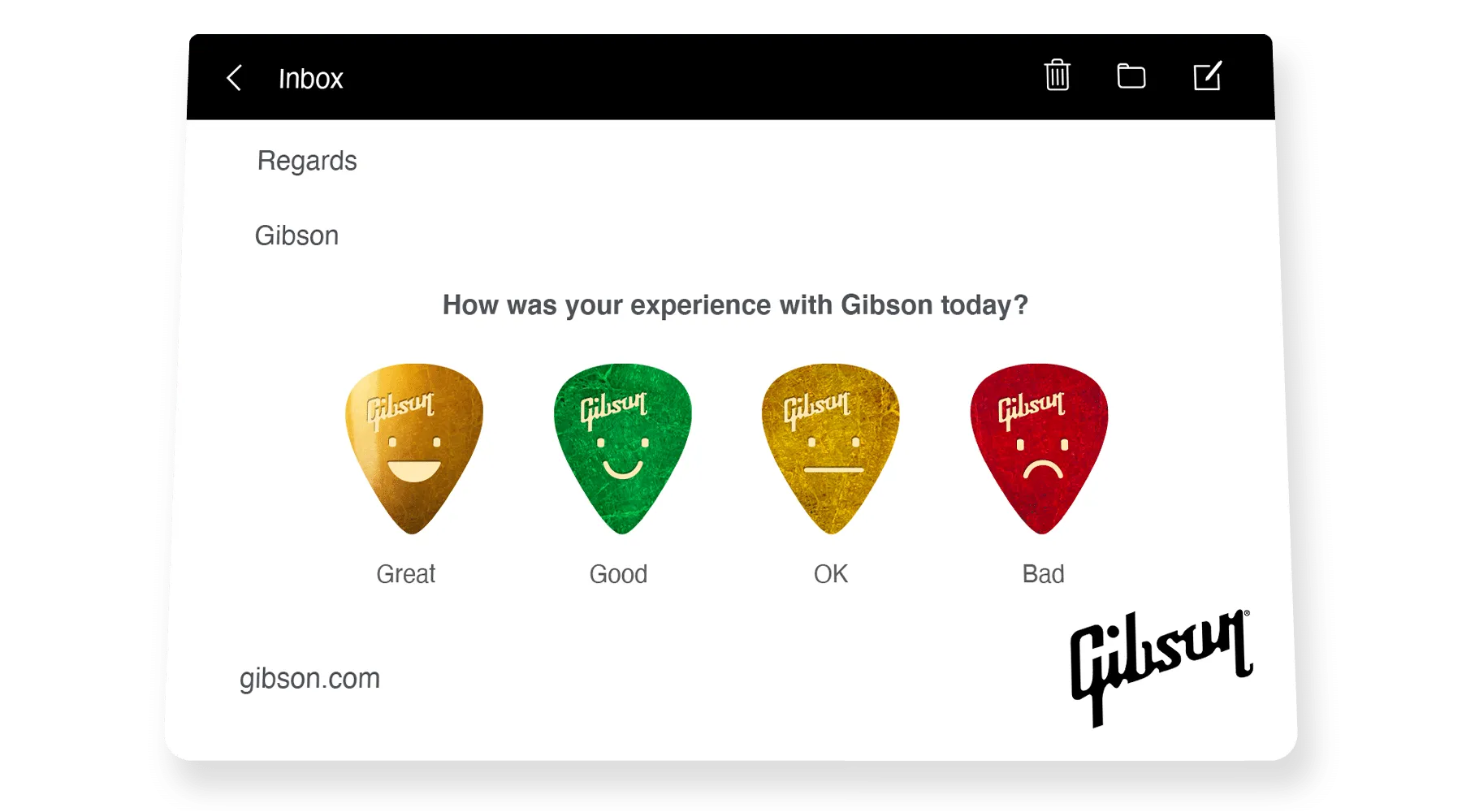
Strike a chord and don’t fret with these customer feedback pickup ideas for Gibson
Gibson is one of the most iconic brands for those who love guitars and guitar music. In this example, we’ve combined the ‘smiley face’ notion of feedback response icons with an emblematic aspect of the Gibson experience – playing the strings with a plectrum.
Each plectrum is a different color and the brand logo is prominently displayed for an unmistakable extension to the brand experience.
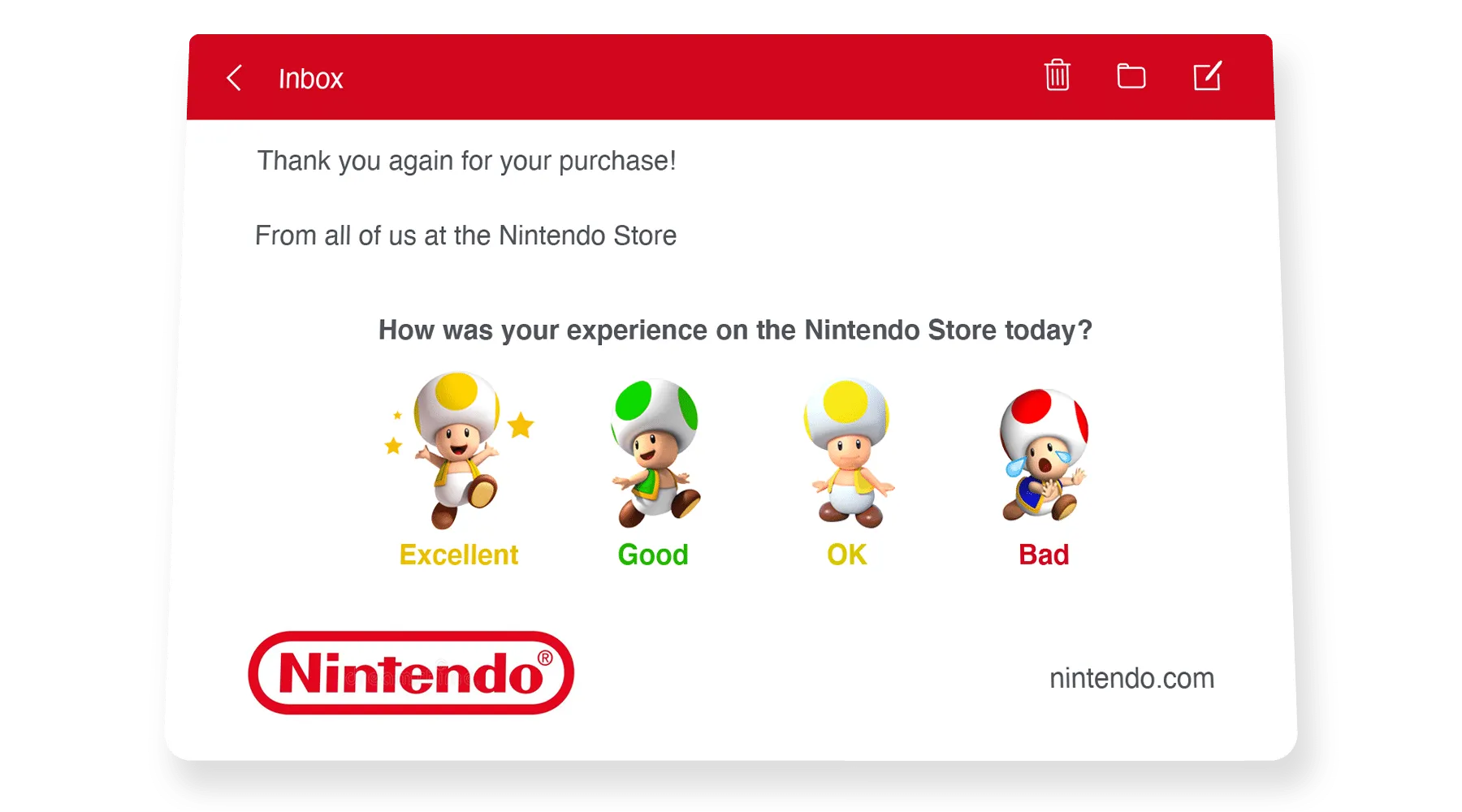
Play for high scores with customer feedback designs for Nintendo
This example is another one intended to chime with well-known brand properties. In this case, the various incarnations of the Toad character from Nintendo’s Mario Bros franchise.
Emotional response is part of the exchange here, and the overall sense is one of fun and participation while still treating the concept of customer feedback with respect.
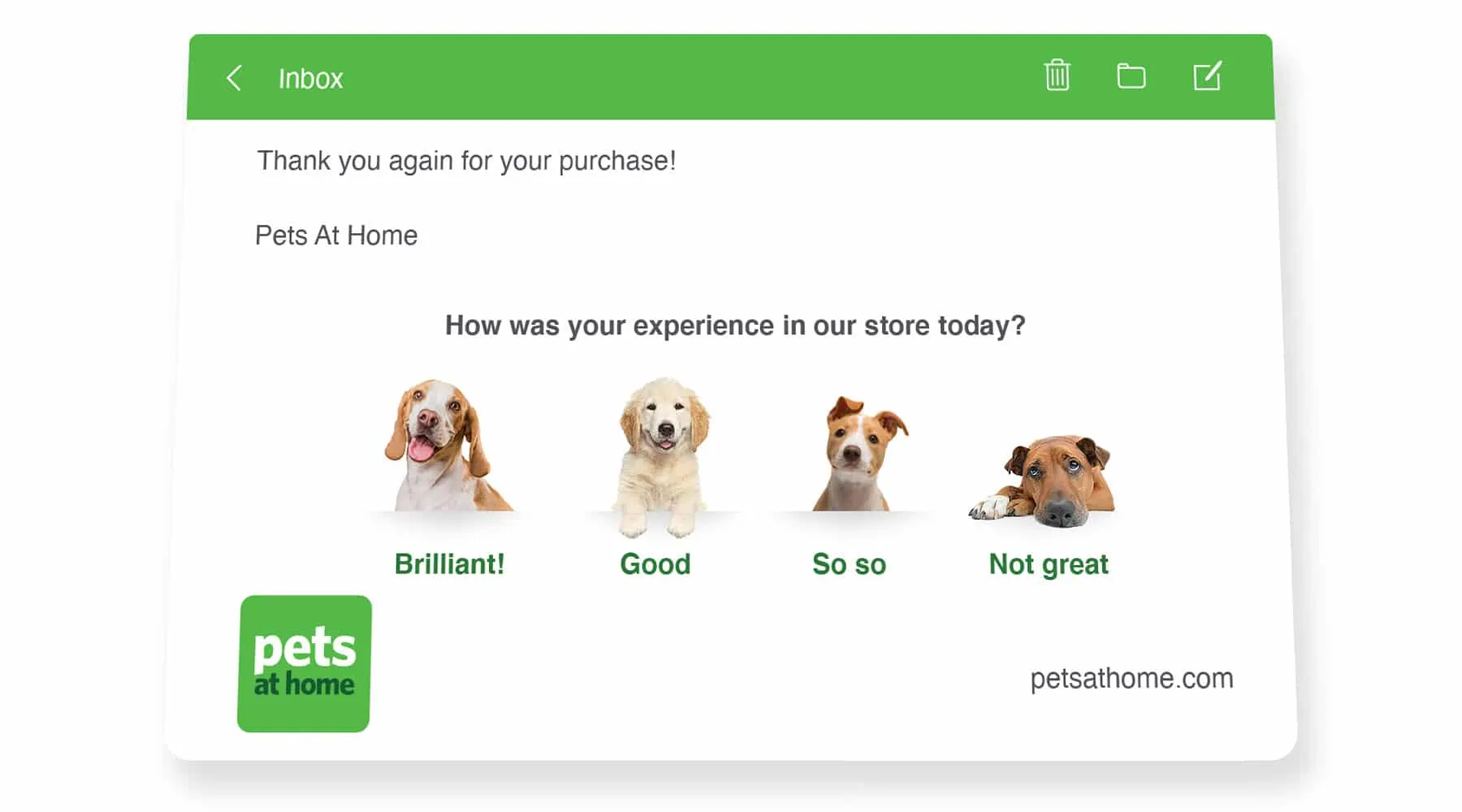
Sniff out honest customer feedback with this dog-inspired concept for Pets at Home
The idea at play here, for popular UK pet store chain Pets at Home, is that each feedback icon is replaced with a photograph of a seriously cute puppy dog.
Like the Gibson example, this is less about using the product (pet stores stock thousands of products) and more about adding a dimension that makes sense in terms of the brand and customers’ expectations around that brand. That’s what makes it feel consistent, along with the careful attention to brand colors, etc.
Take the temperature of customer sentiment with brand-aligned icons for Customer Thermometer
In this final example, here is the simple branding approach taken for Customer Thermometer’s very own feedback response icons. Note how the color scheme matches that of the brand, and the face used in the CT logo. This is combined with traditional traffic light coding (plus Gold!) and facial expressions that negate the need to label each response so customers know what each one means.

Get started today with a free trial
Your name *
Your company *
Your email address *
Your password *
Comments