
Survey vs Questionnaire vs Poll: Which one to use?
What’s the difference between a survey and a questionnaire? Or a questionnaire (or survey) and a poll? This guide explains all, with some great examples and tips to help you choose the right approach.
What is a survey?
A survey is an end-to-end research process that collects data from people by asking them questions. “Survey” describes the whole exercise from coming up with a research rationale to designing questions, asking respondents, gathering data, analyzing it and drawing conclusions.
What is a questionnaire?
A questionnaire is simply a collection of questions. That’s it! The word comes from the French verb questionner (to question). Questionnaires are very important components within surveys. In fact, without questions a survey doesn’t work at all. It’s like a lion without teeth, a cargo shipment without a payload.
What is a poll?
A poll is a type of survey that only has one question. Polls are unique in that they don’t contain questionnaires within them, as ‘questionnaire’ implies multiple questions.
Why do people mix them up?
We’re all in the habit of using words as synonyms of each other, even when they mean something different. That’s certainly the case with a survey vs questionnaire vs poll. It’s largely left to research experts and purists to always use the correct description for what they mean. Most people who use surveys, questionnaires and polls do so interchangeably.

The differences between surveys, questionnaires and polls
Once the differences are pointed out it’s clear there is an obvious logic to it. Here are some pointers to help remind you how:
- A survey is something referred to as an exercise rather than an entity. For example, someone at an organization might say “we need to do a survey”. Or they might use survey as a verb, as in “we should survey customers about X”. Research companies are often ‘commissioned’ to ‘conduct’ surveys. In other uses of the word, surveys are always used to describe thorough and far-reaching endeavors. For example, a property survey.
- A questionnaire is rarely referred to in similar terms to a survey. It’s true that you might want to do, commission or conduct a questionnaire. But you’d never use it as a verb (“let’s questionnaire our employees”). People get mixed up when talking about “sending out a questionnaire” because this feels almost identical to “sending out a survey”. Technically, a stand-alone list of questions (a questionnaire) is seldom just sent out to people without any context or process, like a survey would be. There are very limited instances when a questionnaire would be issued, distributed or sent out.
- A poll is typically associated with voting. The word “poll” originates from old Germanic languages where it meant “head”. Over time, polls and polling became synonymous with the concept of “counting heads”. Votes are usually understood as singular events in response to a single question such as “what/who do you vote for?” But a poll is more than just the question inside it; crucially it’s the finding as well. Opinion polls conducted in the run-up to elections are all about the result and what it means. In this respect, polls are easily understood as being a form of survey.
When to use a survey vs questionnaire vs poll
We’ve established that questionnaires form part of surveys and that polls are a type of survey. However, there are instances where only one of these will be the best approach to use. It all depends on what you’re trying to achieve.
Surveys are for understanding a group of respondents so you can improve how to deal with them
Surveys are for when you need feedback from people, so you can use that to validate or change your approach. There’s no hypothetical limit to the range or number of questions you might want to ask. And you can use any combination of question types to generate qualitative and/or quantitative findings.
Use surveys for the important questions about your organization, and what employees, customers and other stakeholders perceive. Is your product right? Are people happy with your service levels? Are staff motivated and engaged? By asking the right questions of the right respondents at the right time in the right context – your survey will elicit raw data you can analyze to deduce valuable business insights.
The classic examples here are customer satisfaction surveys, NPS surveys, employee pulse surveys, post-event surveys and many more.

Stand-alone questionnaires are for process steps when data is needed to continue
As stated earlier, there are very limited occasions when a questionnaire is the only thing you need. Typically, a questionnaire is just the questions component of a wider exercise designed to understand the people you are studying as part of a survey.
However, sometimes you just need to ask questions without any of the associated rationale and analysis. This is when:
- A process demands the collection of data in order to continue
- The questions (and therefore the results) relate only to the individual being asked
The classic examples are medical questionnaires, insurance waivers and payment information. Questionnaires of this kind are typically closed questions.
Polls are for surgical strikes of respondent opinion but can be aggregated to build strategic insights
Polls are essentially one-question surveys. This makes them ideal for situations where you need a fast turnaround, both in terms of coming up with the question content and analyzing the results. Doing it fast mitigates the fading of memory, making feedback more accurate. The limitation is that you only get one question at a time. Any more than a single question and – strictly speaking – it isn’t a poll.
The obvious application for polls is voting intention, but they are also commonly used to get a hot-take from respondent groups about practically any issue. The results of polls, like any survey, are intended to be representative. Hence, you can ask 1,000 Iowan beef farmers a single question about their views on gasoline costs and be able to present the results as “76% of Midwestern cattle ranchers say gas prices are too high”.
One school of thought is to aggregate the use of multiple one-question surveys as part of an all-encompassing survey strategy. This is because one-question surveys benefit from higher response rates. People are happier to engage with them – and that matters a lot if you want to avoid survey bias.
Survey vs questionnaire vs poll: examples
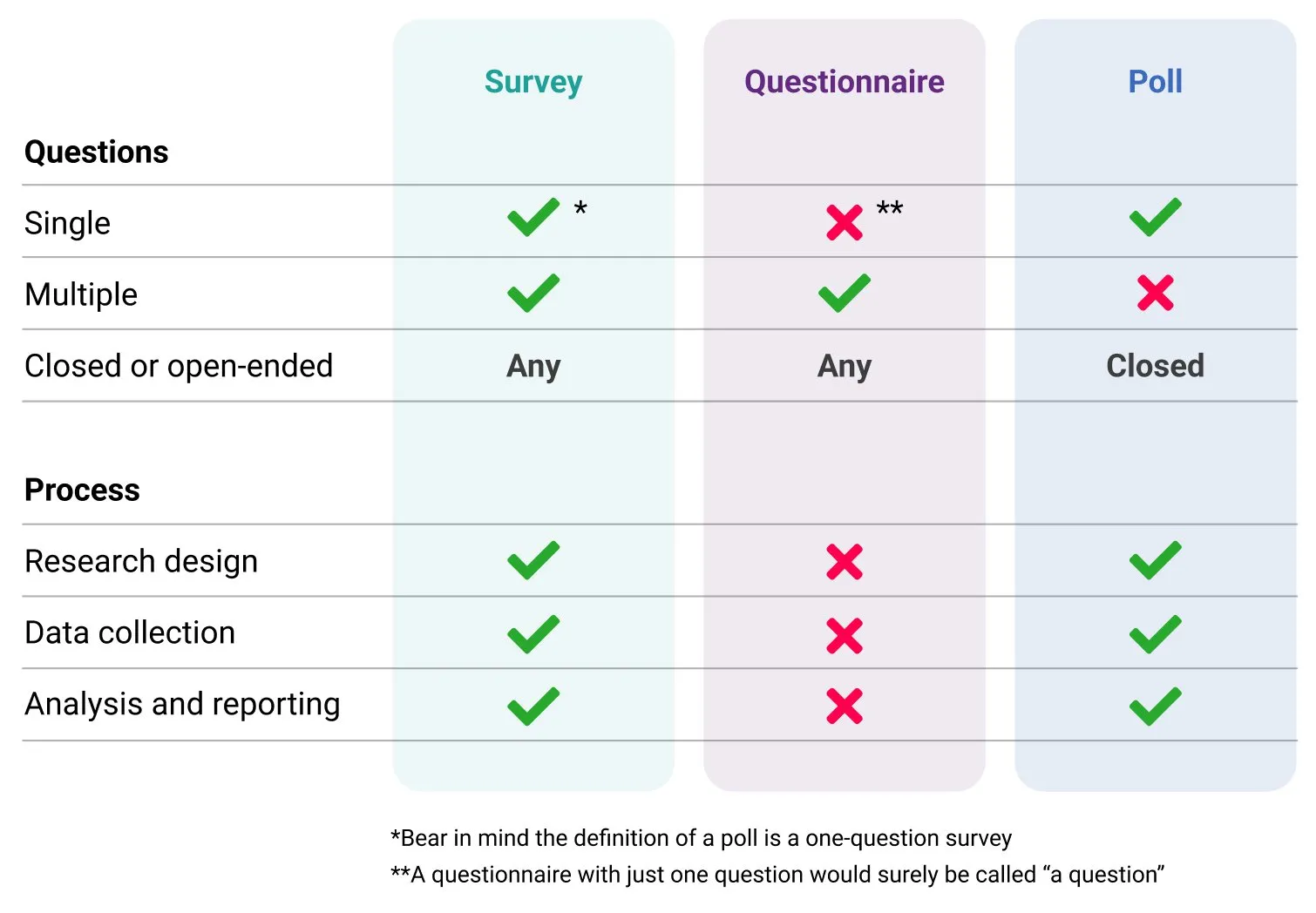
Let’s recap on the major differences between surveys, questionnaires and polls in table form:
Survey examples
-
In-store experience survey
-
-
- You’ve refurbished one of your stores and want to check how customers feel about the improvements. You conduct a survey exercise that explores their opinions from a variety of aspects.
-
-
Post-event staff feedback survey
-
-
- The annual all-hands company kick-off event just finished and 500 staff are (hopefully) returning to their posts fully informed and inspired. You conduct a survey to collect views on everything from favorite sessions to food/beverage quality.
-
-
Beta customer trial survey
-
- Around 50 customers have been using the pre-release version of your latest product and you’re anxious to know what they think. You survey them to isolate any bugs that need ironing out, so you’re confident when it comes to go-live.

Questionnaire examples
-
Medical questionnaire
-
-
- You’re about to receive a beauty treatment, and as a new customer the spa needs to collect some data about your health. As you sit in the waiting area in your robe, you complete the questionnaire and sign.
-
-
Insurance questionnaire
-
-
- Your family is hiring a pedal boat on the lake for 60 minutes. As everyone gets sized up for life preservers, your job is to check the boxes agreeing to waive your litigation rights if the boat sinks.
-
-
Payment information questionnaire
-
- A friend is running a marathon for charity and you’ve clicked the link to donate. Just a few questions are needed to ensure the payment goes through.
Poll examples
-
NPS® (Net Promoter Score) survey poll
-
-
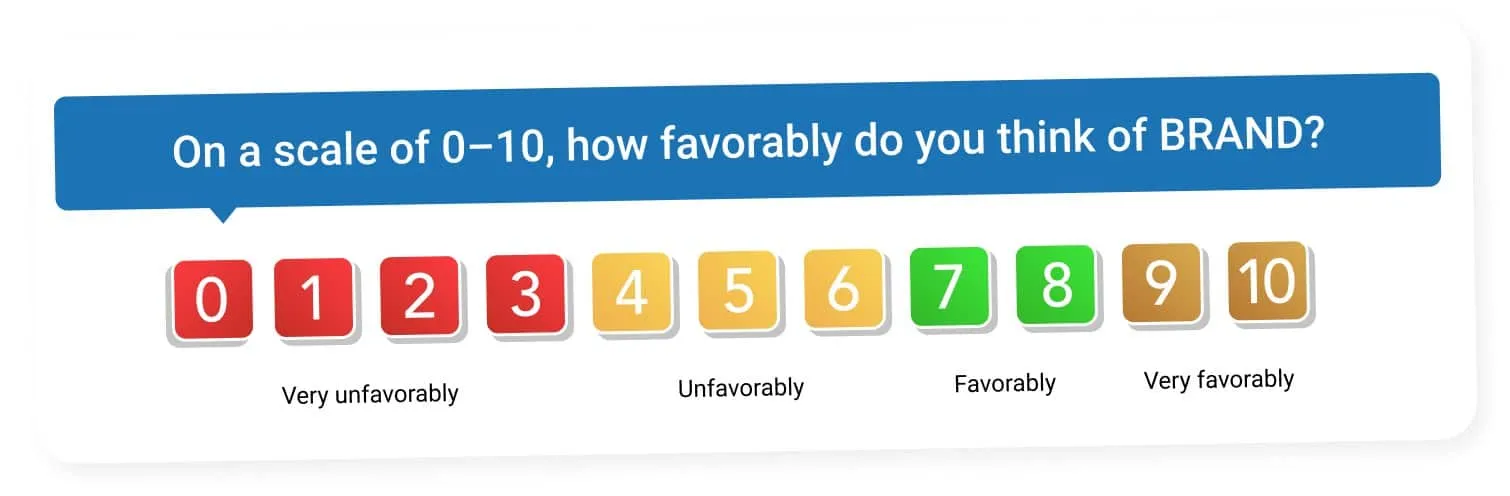
- NPS is the most common form of one-question survey, using a rating system to determine customer loyalty. It’s great for detecting potential customer churn too. It can also be used to create a representative NPS score that can be charted over time. Other metrics like CSAT and CES work in the same way.
-
-
Employee pulse survey poll
-
-
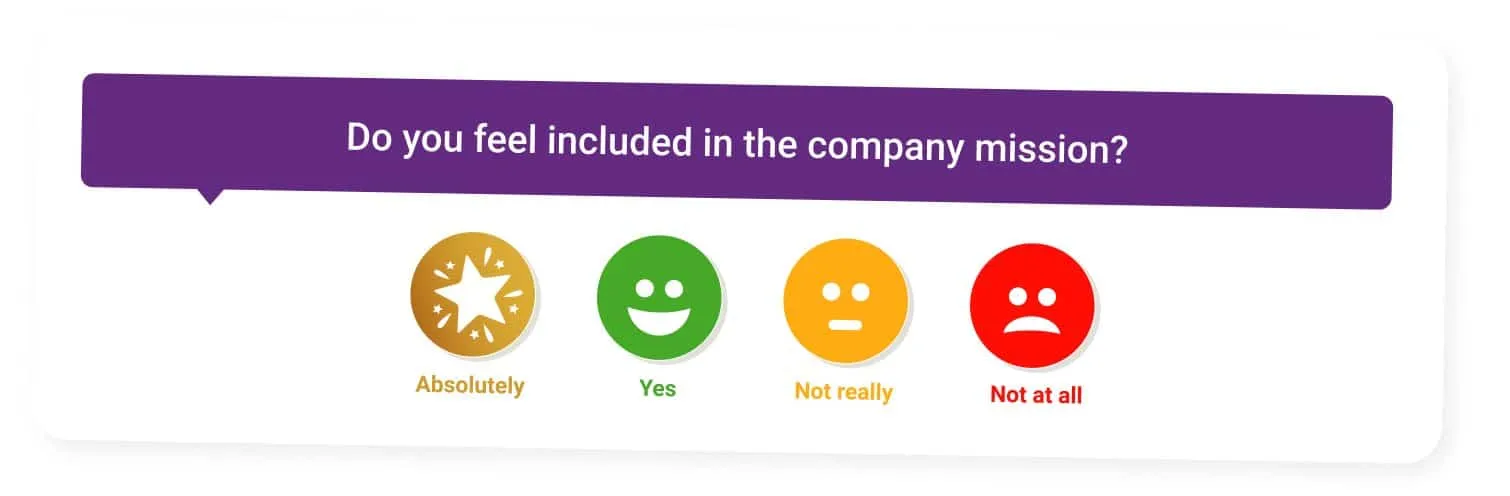
- A pulse survey is a regular check-in with staff. Some businesses collect data from multiple questions, others with just one. For example, “how did your week go?” or “how would you rate your mental health at work right now?”
-
-
Agent performance survey poll
-
- Polls are great for getting at specific parts of the overall customer journey. In this example, you want to know what they thought about the customer-facing agent who just helped with.
What is the best way to create a survey, questionnaire and poll?
First up, there are some general rules that apply to all 3 kinds of research approaches. These are:
-
Know your audience
-
Know your goal
-
Optimize actionability
-
Mitigate bias
Know your audience
Understanding who your survey, questionnaire or poll is being put to should orientate your whole approach. It impacts use of language, length and scope of research, even the types of questions you want to ask. It could also influence your choice of delivery method.
Know your goal
What are you trying to achieve with this exercise? What’s the purpose and the endgame? Work back from what you seek to learn and get to grips with how the data you collect will be used to impact business decisions. That should influence the approach you take on multiple levels.
Optimize actionability
Actionability is frequently overlooked. By that we mean the readiness with which the feedback data you collect can be used to take action. This is particularly important in the way questions are asked, the types of question structure employed and the response options provided. This is key to making efficient and effective use of budget and internal resources.
Mitigate bias
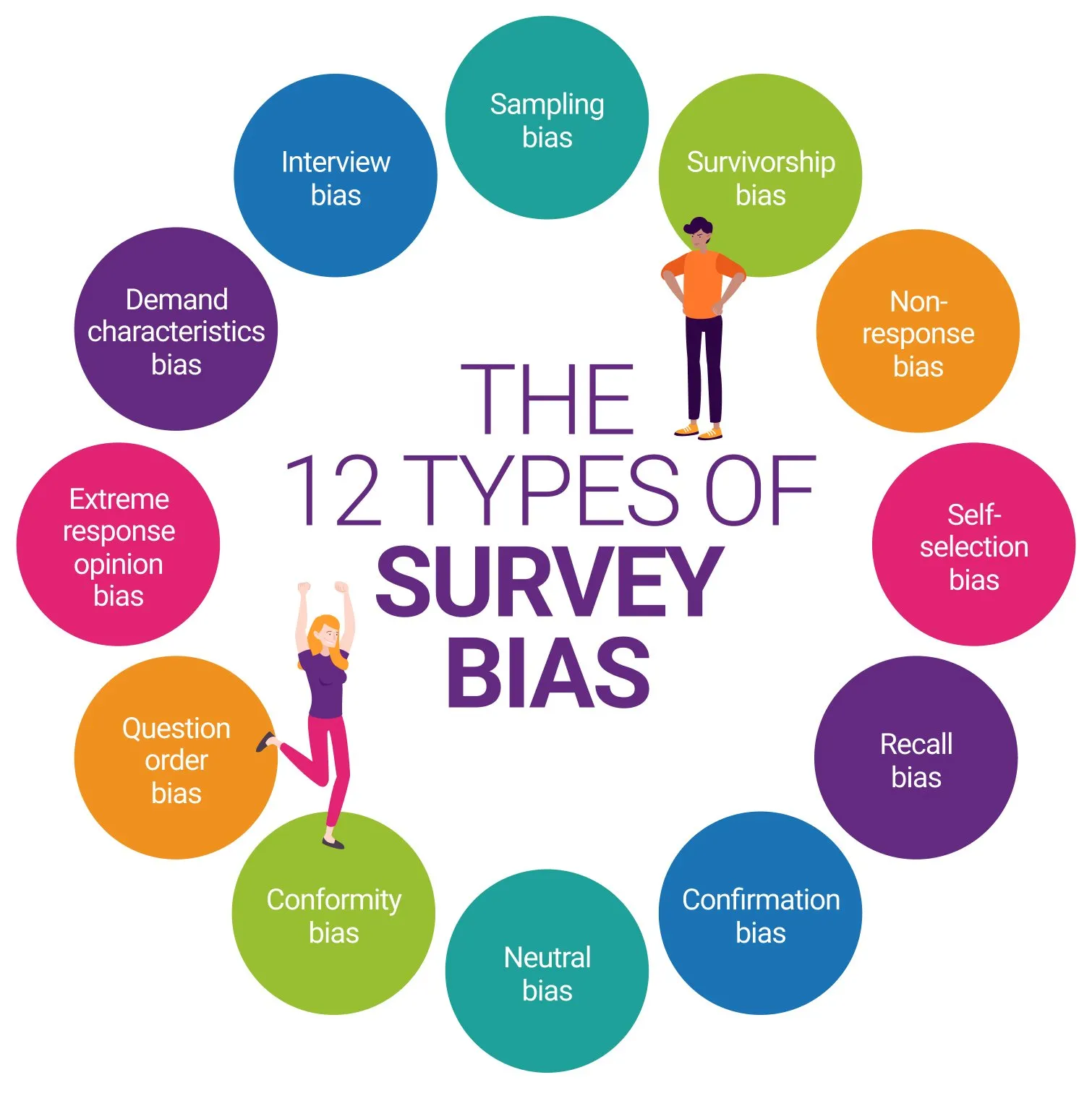
You can’t crawl inside people’s heads to understand their true perspective, and so surveys, questionnaires and polls are the best we can do to find out. But danger lurks in the form of biases that filter and mediate what’s really going on. Most survey biases are subconscious or otherwise unintentional. How you ask people – and how many you ask from certain groups – has a big part to play in making your results accurate and reliable.
Why email surveys, questionnaires and polls are so popular
Surveys, questionnaires and polls can take various forms. Each can be done face to face, for example, using an interviewer to verbalize each question. The interview approach can be done remotely, or even in groups.
In non-interview scenarios, it’s a case of how to get the questions in front of the respondent. Choices here range across all manner of media and comms channels. We counted 41 in all! Chief among these is email, for the following reasons:
- Pretty much everyone has an email address – it’s the most common ID for products, services and subscriptions
- Email usage and adoption of email continues to rise
- Email arrives very soon after being sent
- You’ll already have email details for customers and employees
- You already send emails to customers and employees (they expect to receive more)
- Email is a flexible medium for designing different research approaches
Creating surveys best practices
This best practice actually holds true to all of the approaches. That’s because polls are just a type of survey, and questionnaires are a component of surveys. There’s some specific guidance for those approaches, but you can apply all this survey best practice to everything.
Make it easy for people to understand
Clear, concise questions are a must. Respondents have to see that the survey is relevant to them. Don’t assume any prior knowledge or use insider jargon. See it through their eyes.
Remember you’re asking a favor
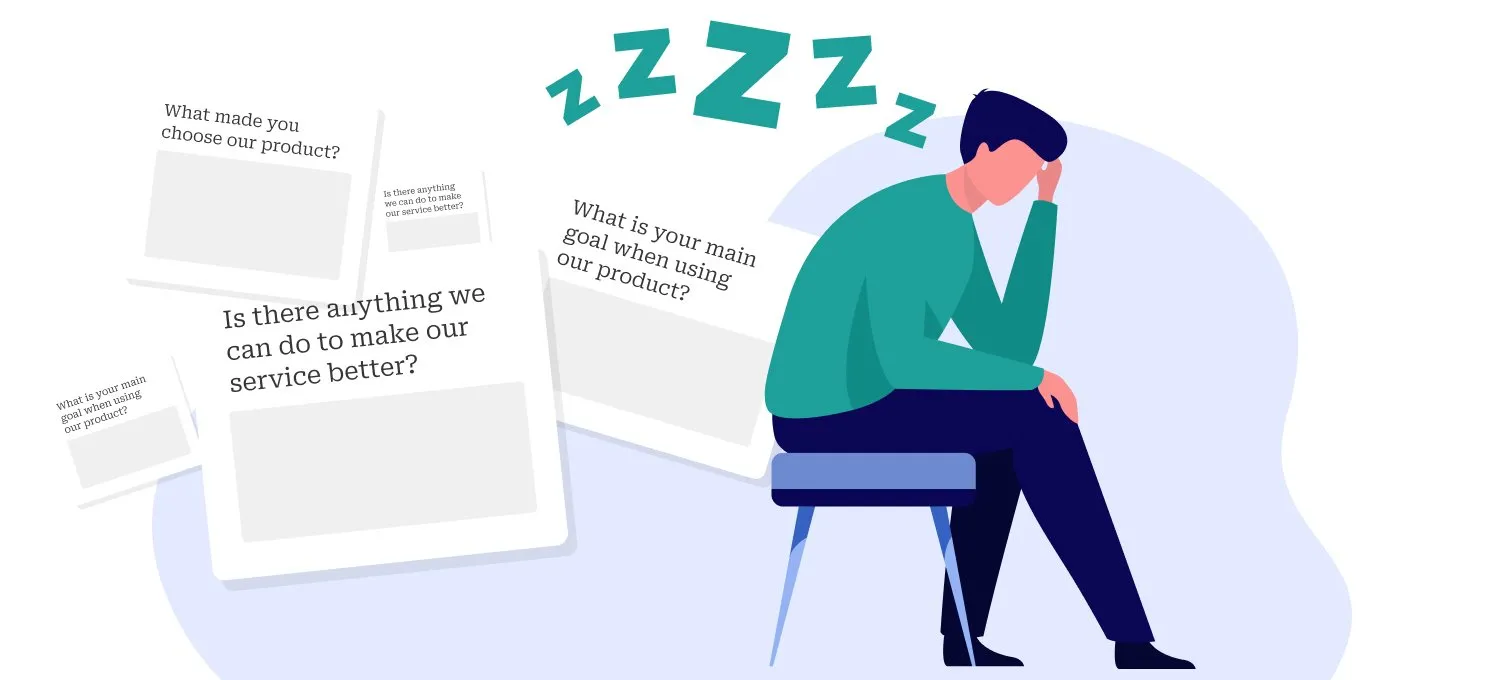
Be courteous in your approach and require the minimum time and effort. Beware of survey fatigue. People have better things to do with their time than fill out your survey. This is crucial to optimizing response rate, which in turn will make your findings more representative and less prone to bias.
Capitalize on context
Timing your survey can help optimize the result. If you’re exploring what people thought of your event, ask them at the event or right after. Memories fade very quickly, and that can hurt data accuracy. Be ready to position your survey accordingly.
Make it a positive experience
Surveys should be engaging. People should want to complete it, not feel like it’s a chore. Use an engaging design, consistent with your brand experience. Consider the use of ratings, scoring scales, response icons and emojis. Show respondents their progress through the experience, and acknowledge them when they complete.
Test, test and test again
Refine your survey design, questions and timings by developing and testing quick prototypes. A/B testing allows you to quickly validate the optimum approach, giving you better response rates and accurate results.
Plan for data influx
Don’t start a survey without planning how to collect, segment and analyze the results. Who’s job is it to read the feedback, present the data and draw conclusions? When does it start and finish? Don’t be a victim of your own success by designing a survey everyone wants to engage with but you don’t have the resources to manage.
Close the loop
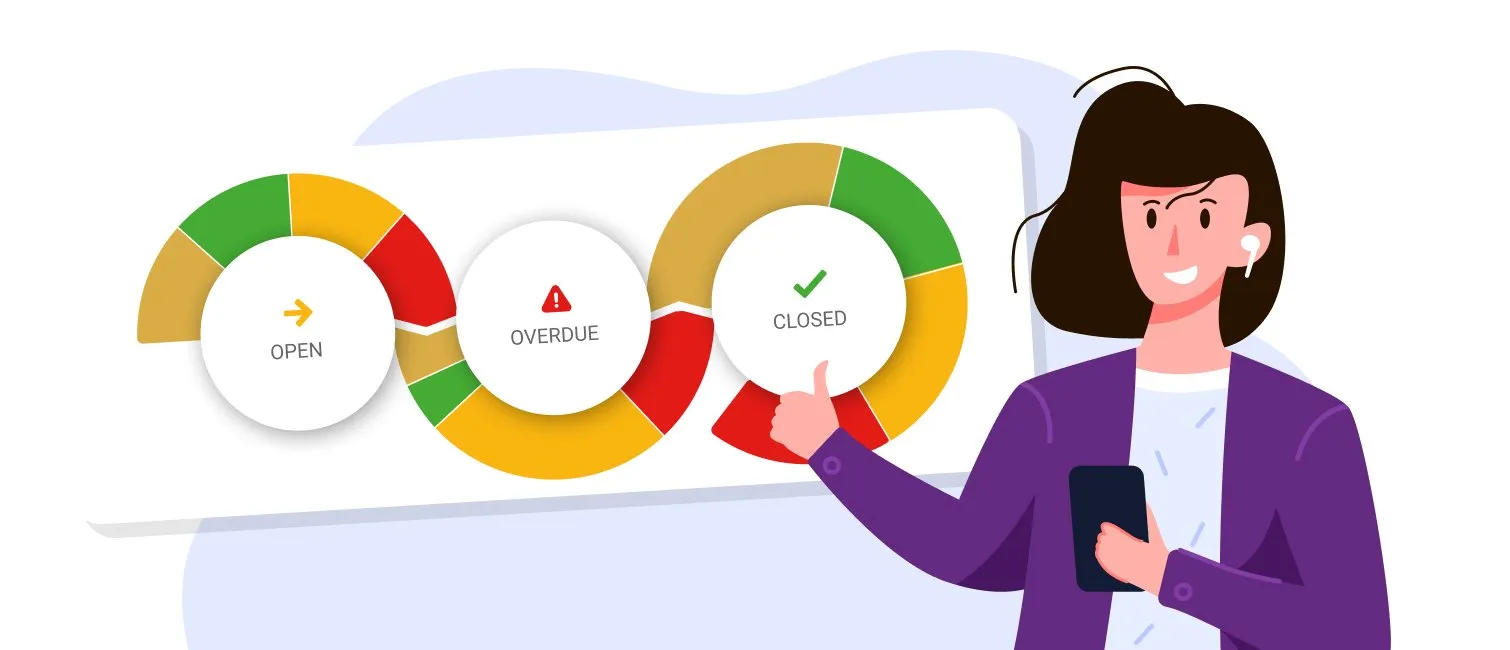
Surveys collect feedback, and if that’s from existing customers and employees it’s essential that you ‘close the loop’. Closing the loop means having a structured approach for getting back to people after they’ve answered your survey. This is crucial for battling customer churn or rushing to help work colleagues in crisis. It helps you jump on issues fast enough to make a difference, and even to change perceptions.
Take action
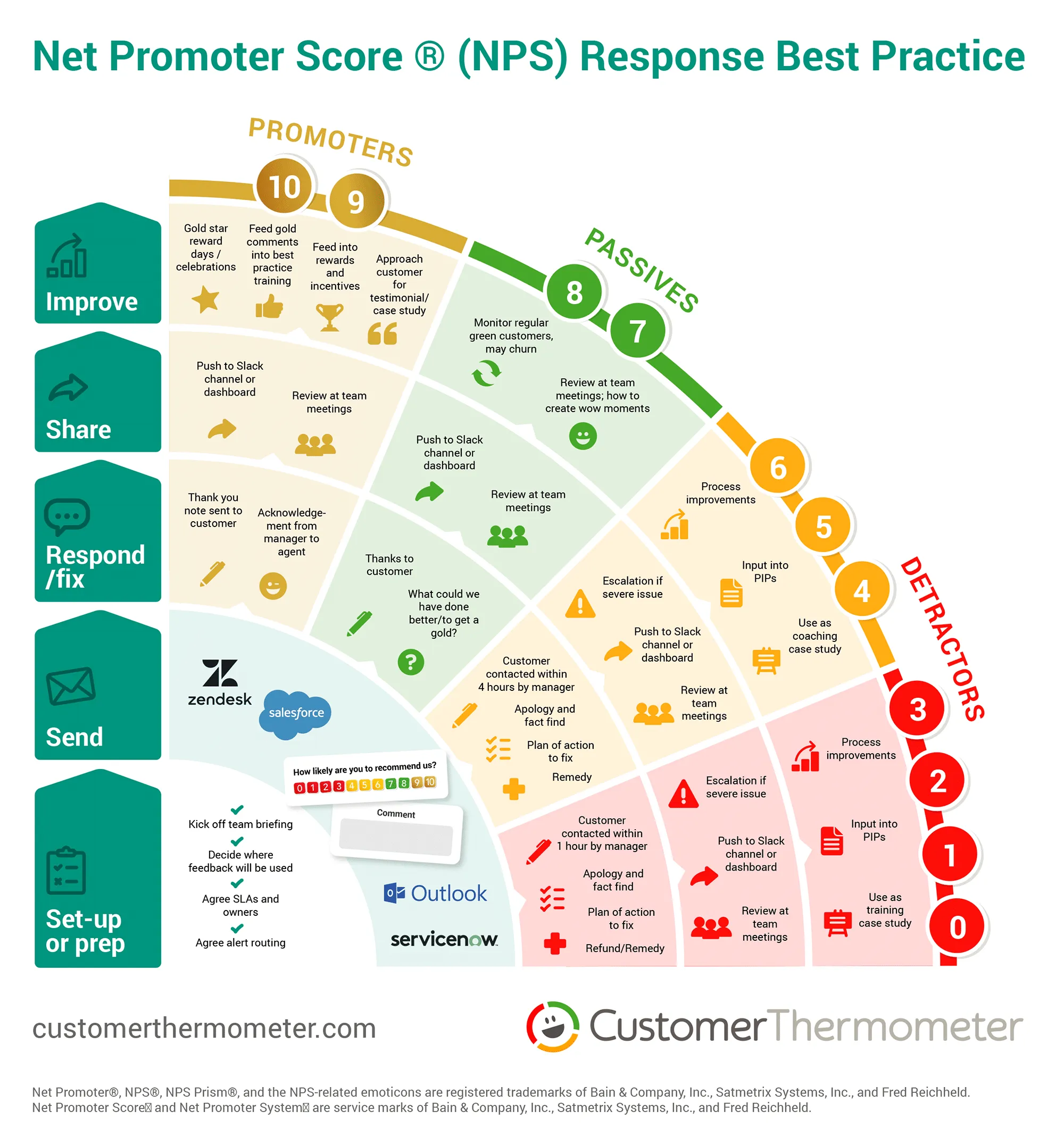
This is arguably the most important piece of survey best practice. If you aren’t going to take action, what’s the point? Get a response planner together so you have some predefined steps for reacting to specific pieces of survey feedback. Your response to a very happy customer, for example, would be very different to a very unhappy one. On a macro level, you should be looking at trends and patterns and how this could influence everything from product development and service delivery to pricing, staff training and brand values.
Creating questionnaires best practices
Questionnaires are simply the group of questions you pose in a survey exercise. So over and above the guidance already provided, let’s look at some best practices around types of questions and how to write them.
Choosing the right question types
There are 10 types of survey questions, and choosing the right one depends on what you’re trying to achieve:
- Open-ended questions
- Good for qualitative insights and really rich, freeform data. Excellent if you can’t easily categorize responses in advance. Bear in mind that analyzing unstructured qualitative data takes more time.
- Nominal (multiple choice) questions
- Respondents will be very familiar with this approach and know what to do. Helps you segment response types easily once responses are in.
- Dichotomous questions
- These are questions with just two possible responses, typically yes/no. Very simple and easy but in certain situations it won’t tell you what you need to know.
- Likert scale questions
- For measuring the intensity of opinion. Typically a range of 5 or 7 responses from very positive to very negative. Helpful to capturing nuances rather than a binary view.
- Rating scale questions
- Popular for simple metrics gathering like NPS and CSAT. Very simple to interact with and makes survey analysis a breeze.
- Contextual follow-up questions
- A great option for placing directly after a simple question to gather deeper insight. For example, after asking for a simple rating or yes/no response, the follow-up question asks why that answer was given.
- Matrix questions
- Matrix questions are a way of presenting multiple similar questions into a compressed format. This speeds up the completion time and makes it feel less daunting.
- Drop-down questions
- Useful when the list of possible answer options is very long and laying out into a multiple-choice format takes up too much room. Asking someone to state their birth year or country of origin can be faster with a dropdown than with multiple options or freeform text.
- Ranking questions
- Otherwise known as ordinal questions. This is helpful in getting respondents to decide between responses instead of sitting on the fence.
- Checkbox questions
- This is where the respondent selects all options that apply. Like with a matrix question, it’s a faster way of presenting and reading questionnaires. A great example is on a medical questionnaire where critical illnesses are listed and you check which you have suffered with in the last 5 years.
Do’s and don’ts of asking questions
Consider the following tips for writing questionnaires:
- Do
- Understand that respondents want to spend the minimum amount of time and effort answering your questions.
- Use words rather than numbers in the response options.
- Ensure questions and response options are as short as possible.
- Be clear and specific.
- Explore one simple idea at a time.
- Remove any potential for misinterpretation and ambiguity.
- Ask ‘straight’ questions that don’t lead the respondent to conclusions.
- Minimize what they need to know in advance to have their opinion count.
- Don’t
- Ask more questions than you need to
- Overcomplicate the question or use jargon.
- Pose ‘double-barreled’ questions that try to ask two questions in one.
- Use loaded questions.
- Make questions overly personal or uncomfortable for the participant.
- Assume your audience has a high level of prior knowledge or experience in order to answer the question.

Creating polls best practices
We’ve covered lots of ground already with survey best practice which also applies here. To briefly recap:
- Make it easy for people to understand
- Remember you’re asking a favor
- Capitalize on context
- Make it a positive experience
- Test, test and test again
- Plan for data influx
- Close the loop
- Take action
Here are some more best practice tips that apply specifically to polls.
Make every word count
Brevity is everything. Polls promise their respondents a limited interaction, to be sure to deliver on that promise.
Explore embedded formats
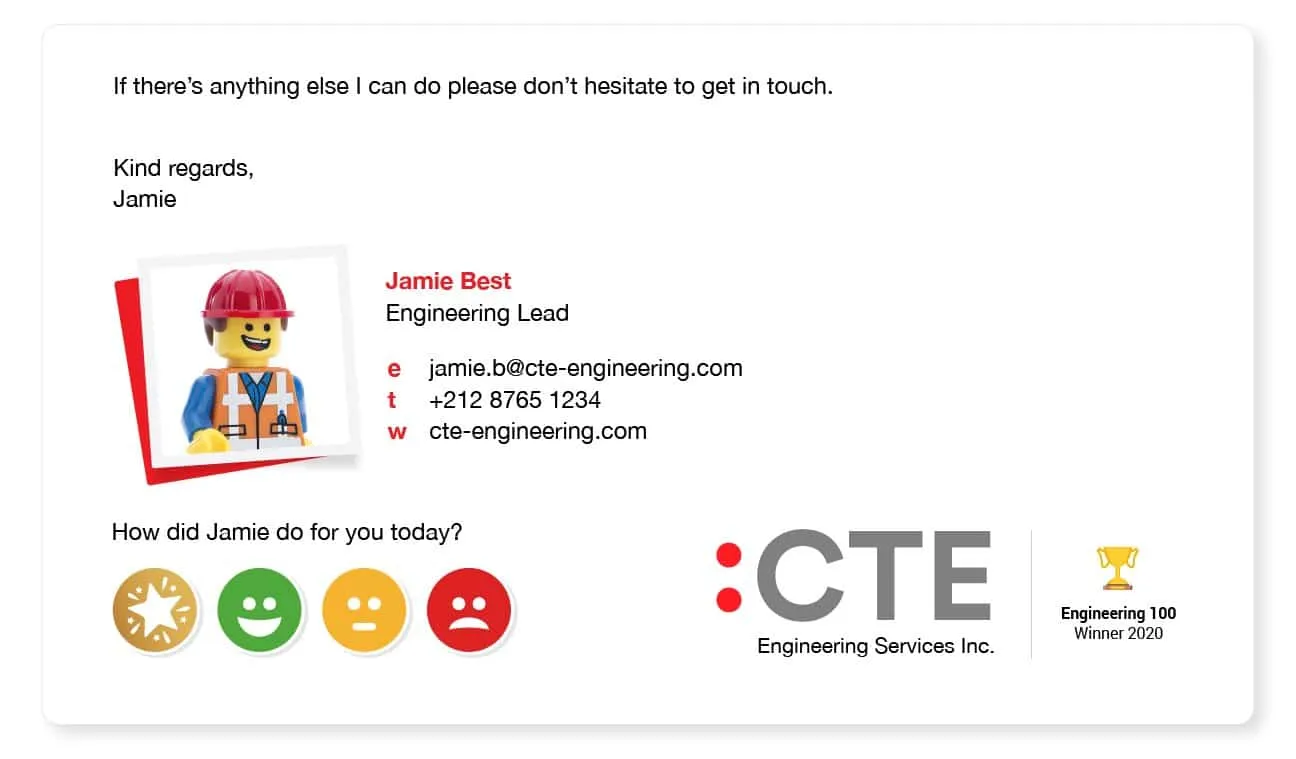
A popular and successful approach with one-question surveys (AKA polls) is to embed them into email signatures. This makes the survey experience even less intrusive and disruptive.
Harness the value of instant feedback
Polls are a great opportunity to collect business intelligence at speed and scale. That’s devastatingly important. Don’t make the mistake of underplaying this value. Think of how quickly you can get questions out into the field, back into analysis and make decisions off the back of them. It’s a real competitive weapon.

Take multiple bites of the cherry
The difference between a survey and a poll is the number of questions. But don’t think of it as either/or. Multiple polls can add up to a larger survey – it’s just broken down into smaller chunks. This smaller size can be very beneficial to optimizing response rates and ensuring the relevance of your questions to the audience and your business objectives.
Build a survey strategy one question at a time
Taking the thinking above to its natural conclusion is the concept of using polls (or one-question surveys) as your default research approach. Lots of organizations do this, both for customer feedback and employee feedback. It’s strategic because it allows you to learn and evolve your research approach, being guided by new findings to zoom in on key issues. Aligned to this is the idea of using one-question surveys to map and evolve each step in complex customer/employee journeys. Even a big survey couldn’t cover that much ground and wouldn’t have the context of individual polls.
Whatever your preference – use Customer Thermometer
Whether you want to set up a beautiful one question survey or a poll – Customer Thermometer is the tool to do it all. Our free trial should give you plenty of opportunities to experiment with fast, effective feedback. We integrate with practically every platform and generate some of the best response rates in the business.
Your name *
Your company *
Your email address *
Your password *
Comments